



The AI boom is changing the technology job market faster than ever.
Companies are no longer hiring only traditional software developers. They are looking for professionals who can build AI systems, automate business processes, work with AI models, analyze data and turn emerging technologies into real business outcomes.
For skilled professionals, this shift is creating opportunities that can potentially cross the ₹50 lakh-per-year mark.
But there is an important catch: simply knowing how to use ChatGPT is not enough.
If you want to compete for high-paying AI and technology roles in 2026, you need a combination of technical knowledge, practical experience and business understanding.
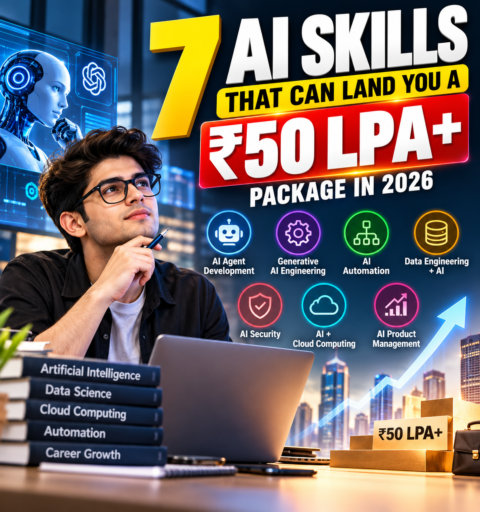
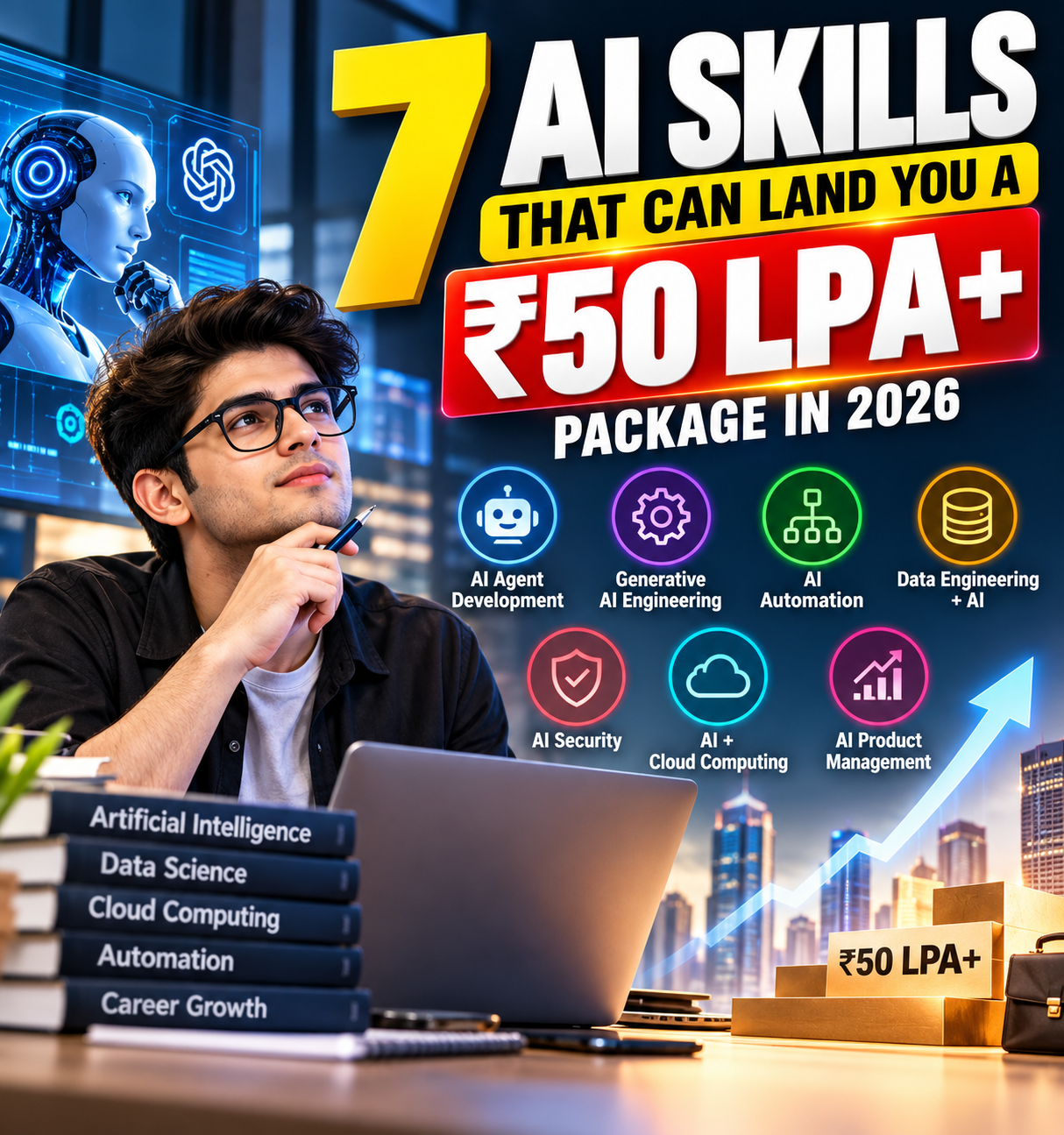
Here are seven AI skills worth learning.
1. AI Agent Development
AI agents are becoming one of the most exciting areas of artificial intelligence.
Unlike traditional chatbots, AI agents can understand a goal, make decisions, use tools, access information and complete multiple steps with limited human intervention.
For example, an AI agent could:
- Research potential customers
- Analyze company data
- Write a personalized email
- Update a CRM
- Schedule a meeting
- Generate a report
Professionals who understand agent architecture, tool calling, APIs, memory, retrieval and workflow orchestration can become extremely valuable to companies adopting AI automation.
What to learn
Start with:
- LLM APIs
- Function/tool calling
- Agent workflows
- RAG
- Vector databases
- Python
- APIs and webhooks
- Agent orchestration frameworks
- AI automation platforms
The key is not simply building another chatbot. Build agents that solve measurable business problems.
2. Generative AI Engineering
Generative AI has moved far beyond simple text generation.
Companies are building applications that generate text, images, audio, video, code and structured business data.
Generative AI engineers work on integrating these models into real-world applications.
You should understand concepts such as:
- Large Language Models
- Prompt engineering
- Structured outputs
- Embeddings
- RAG
- Model evaluation
- Fine-tuning
- Multimodal AI
- API integration
You don’t necessarily need to train a massive model from scratch.
In many cases, the valuable skill is knowing how to take existing models and build reliable products around them.
3. AI Automation
AI automation could become one of the most practical AI skills for businesses.
Imagine connecting:
AI model → CRM → Email → WhatsApp → Google Sheets → Analytics
and allowing the entire workflow to operate automatically.
Companies are increasingly looking for people who can identify repetitive processes and replace manual work with intelligent automation.
Useful tools and technologies
Professionals can explore:
- APIs
- Webhooks
- Zapier
- Make
- n8n
- Python
- CRM integrations
- LLM APIs
- Database automation
The most valuable automation professionals don’t just know the tools.
They understand the business process first and then determine where AI can create the biggest impact.
4. Data Engineering + AI
AI is only as useful as the data behind it.
This is why data engineering remains an important skill in the AI economy.
Companies need professionals who can collect, clean, transform, store and deliver data to AI systems.
Learn:
- SQL
- Python
- Data pipelines
- APIs
- Cloud databases
- Data warehouses
- ETL/ELT
- Data visualization
- Data governance
Add AI knowledge to these fundamentals and you create a powerful combination.
For example:
Data Engineering + Python + Cloud + AI = High-value technical skill stack
5. AI Security
As companies deploy AI systems, security becomes increasingly important.
AI applications can introduce new risks involving data leakage, prompt injection, unauthorized access, malicious inputs and model misuse.
This is creating demand for professionals who understand both cybersecurity and AI.
Important areas include:
- AI application security
- Prompt injection
- Data privacy
- Model security
- Identity and access management
- Secure API architecture
- AI governance
- Risk assessment
Cybersecurity professionals who add AI expertise can position themselves for emerging roles in AI security and governance.
6. AI + Cloud Computing
AI applications require serious infrastructure.
From model deployment to data processing and scalable applications, cloud platforms are becoming an essential part of modern AI development.
Learn at least one major cloud ecosystem and understand:
- Cloud architecture
- Containers
- APIs
- GPU infrastructure
- Serverless computing
- Databases
- Model deployment
- Monitoring
- CI/CD
Combining cloud engineering with AI can make your profile much stronger than learning AI tools alone.
7. AI Product Management
Not every high-paying AI professional needs to be a hardcore programmer.
AI product managers and technical product professionals need to understand how AI can solve real customer and business problems.
A strong AI product professional should understand:
- AI capabilities and limitations
- User research
- Product strategy
- LLM applications
- AI APIs
- Data requirements
- Model evaluation
- Product analytics
- AI ethics and governance
The ability to translate business problems into practical AI products can be extremely valuable.
The Real ₹50 LPA Skill Stack
One mistake people make is trying to learn everything.
You don’t need 20 AI skills.
Instead, build a complementary stack.
For example:
Developer
Python + Cloud + LLMs + AI Agents + APIs
Data Professional
SQL + Python + Data Engineering + Cloud + AI
Marketer
Performance Marketing + Analytics + AI Automation + AI Agents + CRM
Product Professional
Product Management + LLMs + Data + AI Strategy
Cybersecurity Professional
Cybersecurity + Cloud + AI Security + Automation
The combination is often more powerful than any individual skill.
Can These Skills Really Guarantee a ₹50 LPA Salary?
No.
Learning these skills does not automatically guarantee a ₹50 lakh package.
Your compensation will depend on factors such as:
- Experience
- Company
- Location
- Technical depth
- Interview performance
- Communication
- Portfolio
- Problem-solving ability
- Business impact
- Negotiation
A better way to look at the ₹50 LPA target is this:
Don’t chase the salary. Build skills that create ₹50 LPA-level value.
Someone who can save a company millions of rupees through automation, build a scalable AI product or solve a difficult technical problem can command significantly more value than someone who simply knows how to use popular AI tools.
How to Start
If you’re starting from scratch, don’t try to learn everything simultaneously.
Months 1–2
Learn:
- Python fundamentals
- APIs
- SQL
- Git
- AI fundamentals
Months 3–4
Learn:
- LLM APIs
- Prompt engineering
- RAG
- Vector databases
- AI application development
Months 5–6
Build:
- AI chatbot
- AI research agent
- AI automation system
- AI-powered SaaS prototype
Months 7–12
Specialize in one area:
AI Agents / AI Engineering / AI Security / AI + Cloud / Data + AI / AI Product
Then build a portfolio demonstrating real business outcomes.
Final Takeaway
The AI job market is moving from simply knowing how to use AI tools toward knowing how to build, integrate, automate and manage AI systems.
The professionals who combine AI with another valuable domain—software engineering, cloud, data, cybersecurity, marketing or product management—may have the strongest opportunities.
A ₹50 LPA package should therefore be treated as a target, not a promise.
The real goal is to become someone who can use AI to solve expensive problems.
Learn AI. Build real projects. Measure the impact. Then let your skills determine your market value.