
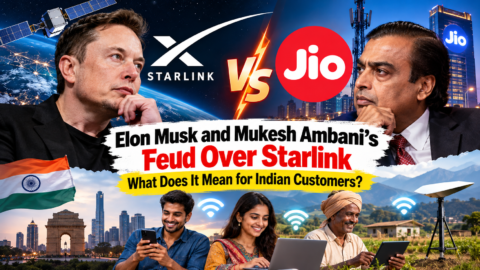





Elon Musk’s Starlink is once again at the centre of India’s technology and telecom debate. The SpaceX-owned satellite internet company has spent years preparing to enter the Indian market, but its commercial launch remains tied to regulatory, security and spectrum-related requirements.
The latest development has made the issue even more prominent. Musk has publicly criticized delays surrounding Starlink’s Indian launch and argued that satellite internet could provide connectivity to communities that remain poorly served by conventional broadband and mobile networks. The Indian government, however, has rejected claims that Starlink is being deliberately blocked, saying that satellite operators must satisfy the same regulatory and security requirements. Reuters
What Is Starlink?
Starlink is a satellite broadband service operated by SpaceX, the aerospace company founded and led by Elon Musk.
Unlike traditional broadband, which relies heavily on terrestrial fibre, cable or mobile towers, Starlink uses a network of satellites in low Earth orbit to provide internet connectivity to terminals on the ground.
This approach can be particularly useful in locations where building fibre networks or mobile towers is expensive or geographically difficult.
For India, that could have significant implications.
Why India Matters to Starlink
India has one of the world’s largest internet populations, but connectivity is not distributed equally between urban and rural areas.
According to figures cited in reporting based on TRAI data, India had more than 1 billion internet subscriptions in March 2026, while rural internet subscription density remained significantly below the urban level. More than 11,000 listed villages were also reported to have no 4G coverage as of May 2026. The Indian Express
This is where Musk sees an opportunity.
In August, Musk said that Starlink could help the least-served communities in India, particularly rural areas. The argument is straightforward: satellite connectivity does not require every remote community to have a traditional fibre connection or nearby mobile tower.
For villages in mountainous regions, islands, deserts and other difficult-to-connect locations, satellite broadband could potentially become an additional connectivity option.
Musk’s Latest Push for India
Starlink’s India story has become more complicated in recent weeks.
Musk has accused unnamed “oligarchs” of attempting to prevent Starlink from entering India in order to protect existing market power. He has also argued that Starlink could provide affordable high-speed connectivity to people currently underserved by existing networks. The Indian Express
The Indian government has rejected those allegations.
According to the Ministry of Communications, satellite service providers must meet security requirements before moving to the next stages of the regulatory process. The government has said that Starlink, Jio Satellite Communications and Eutelsat OneWeb are broadly at similar stages of the security assessment process. The Indian Express
That distinction is important. While Musk’s comments have generated headlines, the commercial availability of Starlink in India ultimately depends on regulatory approval rather than social-media announcements.
Starlink vs Jio and Airtel
India is not waiting for only one satellite internet provider.
Reliance Jio is developing its own satellite broadband ambitions, while Bharti-backed Eutelsat OneWeb is also seeking to expand satellite connectivity services in India.
Interestingly, Starlink has also entered partnerships with both Jio and Airtel for distribution-related plans, illustrating that competition and collaboration can exist simultaneously in the emerging satellite communications market. Business Standard
For Indian consumers, increased competition could eventually mean more choices.
But price will be one of the biggest challenges.
Can Starlink Be Affordable in India?
This may be Starlink’s biggest test.
India has some of the world’s lowest mobile data prices. That means Starlink cannot simply bring a premium satellite-internet model to the country and expect mass adoption.
Musk has recently emphasized that Starlink needs to be affordable in India. Reuters reported that he wants the service priced in a way that makes it accessible to Indian consumers, while arguing that competition could benefit users. Reuters
However, satellite internet requires specialized equipment, and the overall cost structure is different from conventional mobile data.
For an urban household already using affordable fibre broadband, Starlink may offer limited financial advantages.
For a remote business, school, clinic, farm, tourist property or village without reliable broadband, the calculation could be very different.
The Rural India Opportunity
The strongest argument for Starlink in India may therefore not be replacing Jio Fibre, Airtel broadband or other urban services.
Instead, its biggest opportunity could be connecting places where conventional infrastructure is difficult to deploy.
Reliable internet can support:
- Online education
- Digital payments
- Telemedicine
- Small businesses
- Remote work
- E-commerce
- Government services
- Tourism
- Agricultural information
- Emergency communication
For India’s digital economy, connectivity is increasingly becoming basic infrastructure rather than a luxury.
Security Remains a Major Issue
There is also another side to the Starlink debate: national security.
Satellite networks operate differently from conventional telecom infrastructure, and governments need mechanisms to monitor and regulate communications while ensuring that operators comply with local requirements.
India’s authorities have emphasized security assessments as part of the approval process. Earlier incidents involving Starlink hardware found in India also contributed to questions about unauthorized use of satellite equipment. Musk said at the time that Starlink’s satellite beams were turned off over India. Reuters
Therefore, India’s regulatory caution cannot simply be viewed through the lens of business competition.
What Happens Next?
Starlink’s future in India will depend on whether the company can satisfy the remaining regulatory and security requirements and eventually begin commercial operations.
The potential is enormous, but so is the challenge.
India already has an extremely competitive telecom market, inexpensive mobile data and rapidly expanding fibre infrastructure. Starlink will therefore need to demonstrate a clear advantage in the areas where traditional networks struggle.
If Musk succeeds in making Starlink affordable enough while meeting India’s regulatory requirements, satellite broadband could become an important part of India’s connectivity ecosystem.
The bigger story may not be Starlink versus Jio or Musk versus Indian regulators.
It may ultimately be about whether India can use multiple technologies—fibre, 5G, fixed wireless and satellites—to ensure that geography no longer determines who gets reliable internet access.
For millions of Indians living in areas where traditional connectivity remains difficult, that could be the real promise of Starlink.
Hi, this is a comment.
To get started with moderating, editing, and deleting comments, please visit the Comments screen in the dashboard.
Commenter avatars come from Gravatar.