





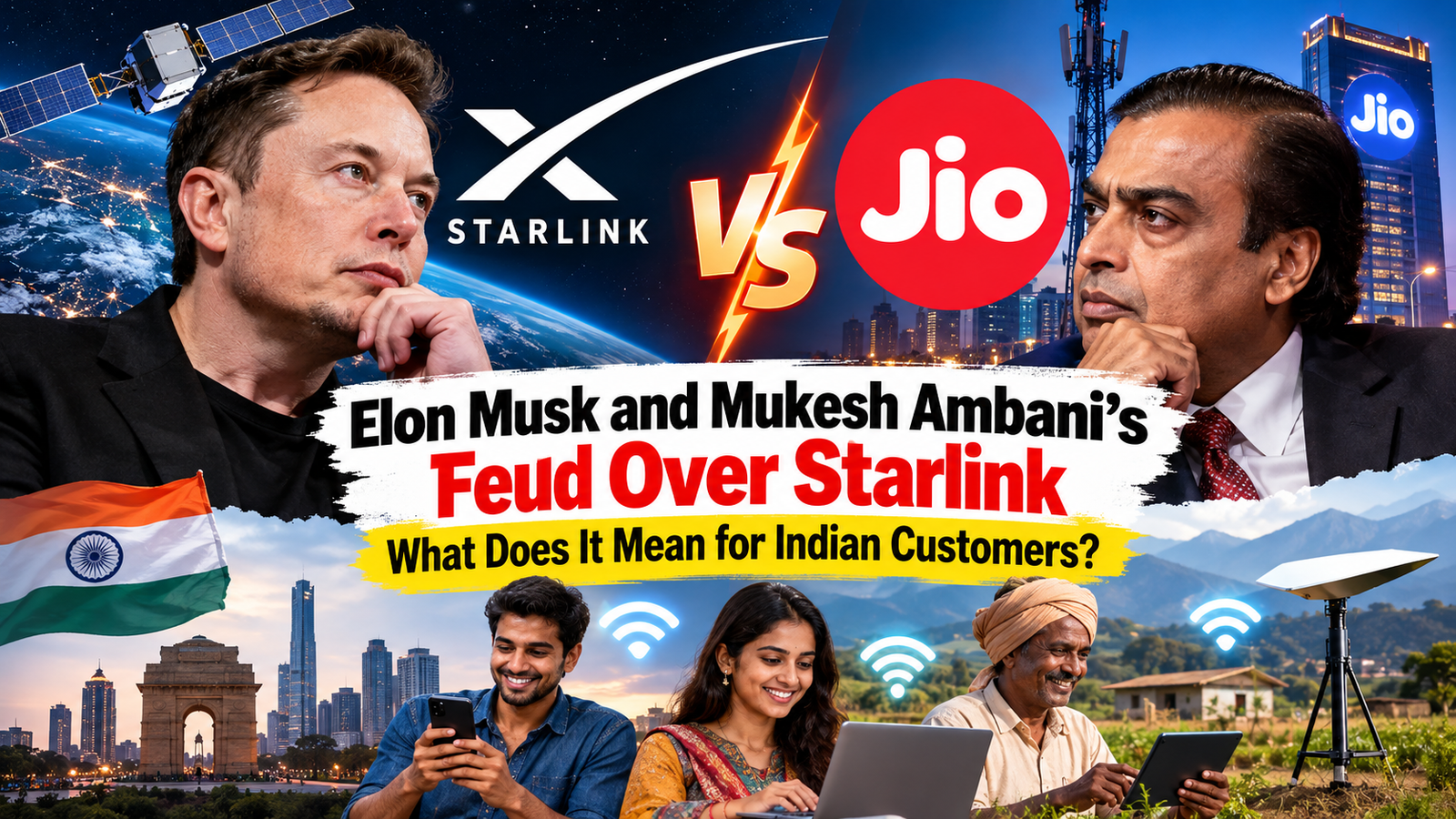
Elon Musk and Mukesh Ambani are now at the centre of an increasingly public battle over the future of satellite internet in India.
What started as a regulatory delay surrounding SpaceX’s Starlink has turned into a war of words, with Musk accusing unnamed business interests of blocking Starlink’s entry into India. He later directly questioned Mukesh Ambani’s influence, asking on X whether “Ambani is the real boss of India.”
But behind the billionaire drama is a much more important question for ordinary Indians:
What will Starlink mean for the customer?
Why are Musk and Ambani clashing?
Starlink wants to provide satellite-based broadband internet across India, particularly in areas where traditional fibre and mobile networks are difficult to deploy.
Reliance Jio, meanwhile, is developing its own satellite communications business. Jio Satellite Communications is one of the companies currently going through India’s regulatory and security process for satellite services.
Musk has argued that Starlink is being held back by powerful interests that want to protect existing telecom businesses.
The Indian government has rejected that claim.
The Ministry of Communications has said that Starlink, Jio Satellite and Bharti-backed Eutelsat OneWeb are broadly at the same regulatory stage and are undergoing security assessments. The government says the framework is fair and non-discriminatory.
So, officially, the dispute is not simply “Musk versus Ambani.” It also involves India’s security requirements, spectrum allocation and the regulatory process for satellite communications.
The interesting part: Jio and Starlink were once partners
The rivalry becomes even more interesting because Jio and SpaceX previously announced a partnership.
In March 2025, Jio Platforms announced an agreement with SpaceX to make Starlink services available to Jio customers in India, subject to the required government authorisations.
Under the proposed arrangement, Jio would sell Starlink equipment through its retail and online channels and provide installation and customer support.
That means the relationship isn’t simply about two companies fighting each other.
There is also a potential scenario where Jio could help distribute Starlink technology while simultaneously developing its own satellite connectivity business.
What is actually delaying Starlink?
Starlink has already obtained important approvals, but commercial operations cannot begin until the remaining regulatory and security requirements are satisfied.
The government has said that security assessments are underway for the three licensed satellite operators.
These requirements are particularly important because satellite networks can potentially provide connectivity beyond the reach of conventional terrestrial infrastructure.
India wants operators to demonstrate compliance with its security conditions before spectrum can be assigned and commercial services can begin.
So, despite Musk’s criticism, Starlink isn’t simply waiting for a single business competitor to give it permission to enter India.
There are government approvals and security requirements that must be completed.
What does this mean for Indian customers?
This is where the story becomes much more interesting.
Indian customers could potentially benefit from increased competition in satellite broadband.
If Starlink, Jio and OneWeb eventually compete for customers, companies will have stronger incentives to compete on:
- Monthly pricing
- Installation costs
- Internet speeds
- Data allowances
- Hardware prices
- Customer support
- Coverage
- Reliability
Union Communications Minister Jyotiraditya Scindia has said that customers will ultimately be able to choose their satellite internet provider once companies meet the required security and regulatory conditions.
For consumers, that is arguably more important than the Musk-Ambani argument itself.
Will Starlink be cheaper than Jio?
This is still uncertain.
Musk has recently acknowledged that Starlink would need to be affordable for the Indian market.
India already has some of the world’s lowest mobile data prices, making the country very different from many markets where Starlink has positioned itself as a premium connectivity option.
Musk said that if Starlink were too expensive in India, customers simply would not buy it, meaning the company would need to make its pricing affordable.
That creates a major challenge.
Indian consumers are highly price-sensitive.
A household already paying a relatively low amount for fibre or 5G may have little reason to switch to satellite internet unless Starlink offers something substantially better.
So who actually needs Starlink?
Starlink’s biggest opportunity may not be India’s major cities.
Urban customers already have access to fibre broadband, 5G and other relatively affordable internet options.
The bigger opportunity could be in:
- Remote villages
- Mountainous regions
- Rural businesses
- Farms
- Construction sites
- Remote schools
- Disaster-affected areas
- Locations without reliable fibre
- Areas with weak mobile coverage
Musk has specifically argued that Starlink could help areas with poor or no internet and places without mobile coverage.
For those customers, the comparison isn’t necessarily “Jio versus Starlink.”
It may be “Starlink versus having no reliable broadband connection.”
What Indian customers are likely to care about
The average customer probably won’t care much about the billionaire feud.
They will ask five simple questions:
1. How much will it cost?
This could be the biggest factor.
India’s broadband market is extremely price competitive, so Starlink will have to find a pricing model that works for Indian households and businesses.
2. Is the speed reliable?
Satellite internet could be particularly valuable in locations where fibre isn’t available.
But customers will want consistent performance rather than simply impressive advertised speeds.
3. How much will the hardware cost?
Unlike a conventional broadband connection, satellite internet requires specialised equipment.
The total cost of installation and hardware could therefore influence adoption significantly.
4. Will it work everywhere?
This is Starlink’s major selling point.
If customers in remote areas can get reliable broadband without waiting for fibre infrastructure, satellite connectivity could become a significant alternative.
5. What happens to existing broadband prices?
Even customers who never buy Starlink could potentially benefit from its arrival.
Competition can force internet providers to improve pricing, packages, speeds and service quality.
That is the consumer angle Musk has been emphasising in his recent comments.
The bigger battle isn’t really Musk vs Ambani
The real competition could eventually be between different technologies and business models.
Jio has an enormous existing telecom and broadband ecosystem.
Starlink has a large low-Earth-orbit satellite constellation and global satellite-internet experience.
OneWeb also has a satellite network and Indian connectivity ambitions.
For Indian consumers, the most important development will be whether these companies can turn satellite internet into a practical and affordable product.
The billionaire feud makes headlines.
But the real story is competition.
Final takeaway
Elon Musk’s confrontation with Mukesh Ambani has turned Starlink’s delayed Indian entry into a major business story.
Musk says competition would benefit Indian consumers, while the Indian government maintains that Starlink is subject to the same regulatory and security process as other satellite operators.
Meanwhile, Jio and SpaceX already have a history of cooperation through their 2025 Starlink distribution agreement.
For Indian customers, the most important question isn’t who wins the argument between Musk and Ambani.
It is whether the arrival of satellite internet gives consumers more choices, better connectivity and competitive prices.
If Starlink eventually launches alongside Jio and OneWeb, India’s internet market could become even more competitive — especially for people living in places where traditional broadband has struggled to reach.