



The AI race has suddenly become much more competitive.
Google has launched Gemini 4 Argon, Meta has introduced Muse Wonder and Muse Wonder Full, and OpenAI’s ChatGPT remains one of the most widely used AI assistants in the world.
For months, the competition appeared to be dominated by OpenAI and Anthropic. But the latest launches from Google and Meta have changed the equation.
So, which AI is actually better in 2026 — Gemini 4 Argon, ChatGPT, or Meta Muse?
The answer depends heavily on what you want to use AI for.
Gemini 4 Argon: Google’s New Heavyweight
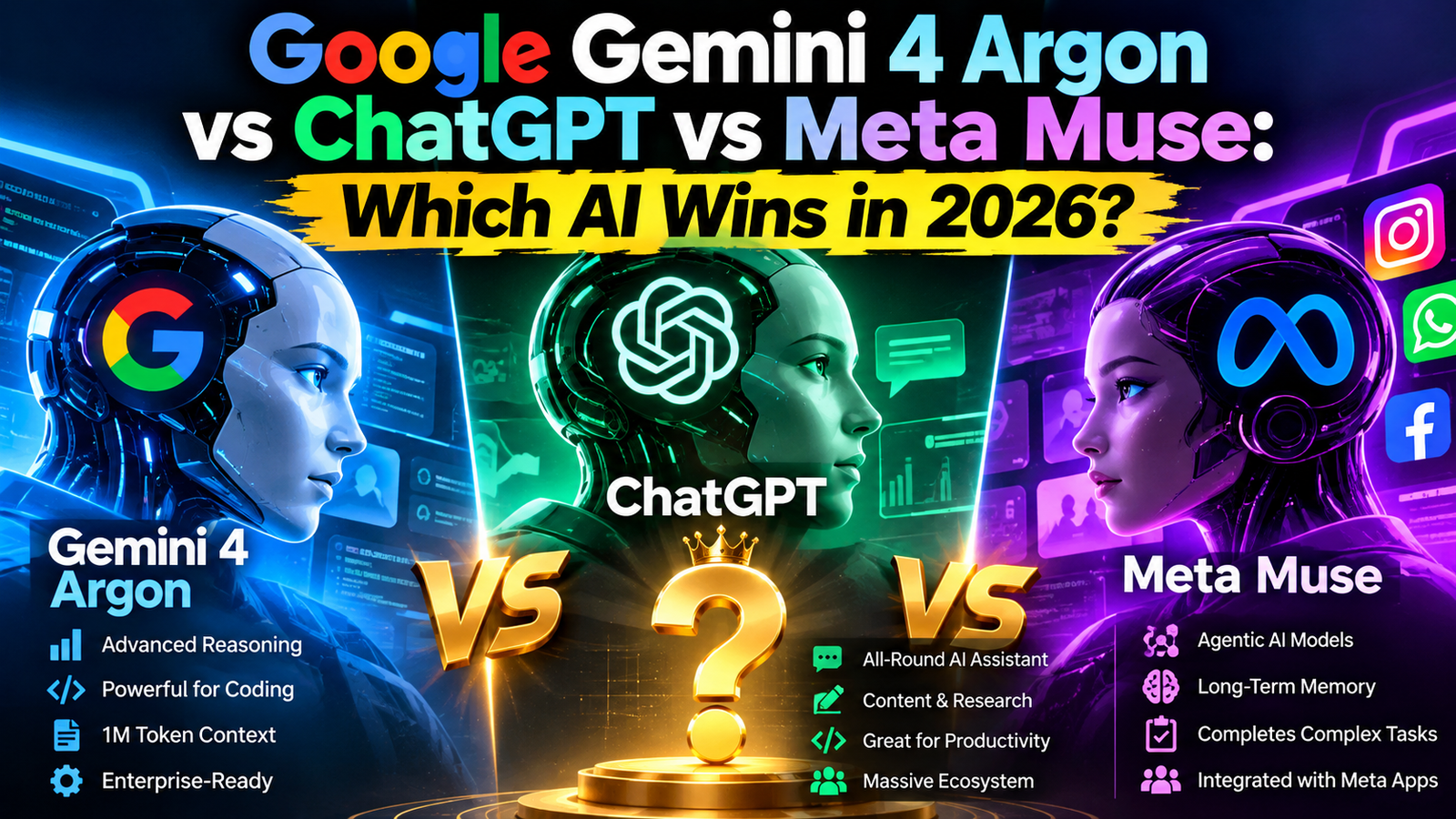
Google launched Gemini 4 Argon on October 13, 2026, positioning it as a model designed for difficult, multi-step work across coding, finance, law, science and cybersecurity. Reuters
One of Argon’s biggest advantages is its ability to maintain context during long tasks.
Google says the model can work with large amounts of information, including documents containing text, tables, charts and images, and turn that information into structured outputs. Google Cloud
The Gemini API documentation lists a 1-million-token context window, long decoding capability and adjustable reasoning levels. Google AI for Developers
That makes Gemini particularly interesting for:
- Software development
- Data analysis
- Research
- Financial modelling
- Legal work
- Large documents
- Complex agentic workflows
- Scientific tasks
Another major advantage is price.
Google launched Argon at an introductory price of $2 per million input tokens and $10 per million output tokens, with standard pricing scheduled to become $4 and $20 respectively after November 30, 2026. Google Cloud
That aggressive pricing could put significant pressure on competing AI providers.
ChatGPT: Still the Most Versatile AI Assistant?
ChatGPT’s biggest advantage isn’t necessarily one individual benchmark.
It’s the ecosystem.
For everyday users, ChatGPT has become a general-purpose AI workspace for writing, research, coding, brainstorming, analysis and automation.
Its biggest strength is versatility.
A marketer, developer, student or business owner can use the same assistant for completely different workflows.
That makes ChatGPT particularly attractive for users who don’t want to constantly switch between specialised AI tools.
The real competition therefore isn’t simply:
Which model has the highest benchmark score?
It’s:
Which AI can become the most useful everyday digital assistant?
Meta Muse: The Agentic Challenger
Meta’s biggest move is arguably different from Google’s.
Instead of simply competing on chatbot intelligence, Meta is pushing toward AI agents.
Meta launched Muse Wonder and Muse Wonder Full on October 12, describing them as its most capable AI models yet. Reuters
The models are designed around longer-running tasks, with features such as Active Memory and Active Focus.
Active Memory helps the system retain relevant information over longer periods, while Active Focus is intended to help it stay focused on completing complex tasks. Android Authority
That’s important because the future of AI may not be about asking:
“What’s the answer?”
Instead, users may simply tell an AI:
“Handle this for me.”
That is where Meta wants Muse to compete.
Gemini 4 Argon vs ChatGPT vs Muse
| Category | Gemini 4 Argon | ChatGPT | Meta Muse |
|---|---|---|---|
| Complex reasoning | Excellent | Excellent | Excellent |
| Coding | Excellent | Excellent | Strong |
| Long-context work | Major strength | Strong | Strong |
| AI agents | Strong | Strong | Major focus |
| Research | Excellent | Excellent | Strong |
| Everyday productivity | Excellent | Excellent | Strong |
| Enterprise use | Major strength | Major strength | Emerging |
| Consumer ecosystem | Google ecosystem | OpenAI ecosystem | Meta ecosystem |
| Long-running tasks | Strong | Strong | Major focus |
| Price advantage | Strong | Depends on plan/model | Subscription-based ecosystem |
The table shouldn’t be treated as a definitive benchmark ranking because these products and models are evolving rapidly, and performance varies depending on the specific task.
So, Which AI Wins?
🥇 Best for complex professional work: Gemini 4 Argon
If your priority is large documents, coding, financial analysis, research or complicated multi-step workflows, Gemini 4 Argon looks particularly compelling.
Its 1-million-token context capability and focus on long-running tasks give it a significant advantage for certain professional workflows. Google AI for Developers
🥇 Best all-rounder: ChatGPT
For people who want one AI assistant that can handle writing, research, coding, brainstorming and everyday productivity, ChatGPT remains an extremely strong choice.
Its biggest advantage is the breadth of the overall product experience rather than simply one technical specification.
🥇 Most interesting AI-agent approach: Meta Muse
Meta Muse is perhaps the most interesting challenger if the future of AI becomes increasingly agentic.
Meta is trying to build an AI that doesn’t simply respond to users but can maintain context and work through longer tasks. Android Authority
That could become extremely powerful when combined with Meta’s enormous ecosystem of consumer products.
The Bigger Story: AI Chatbots Are Becoming AI Workers
The most important development isn’t actually which company wins.
It’s the direction the industry is moving.
The AI race is shifting from:
Chatbots → Reasoning models → AI agents → Autonomous digital workers
Google’s Argon is designed for complex multi-step work.
Meta’s Muse is being developed around persistent, agentic experiences.
OpenAI continues building ChatGPT into a broader AI platform.
This means the next generation of AI may not wait for humans to provide every individual instruction.
Instead, you could give an AI a goal and allow it to figure out the steps required to achieve it.
Final Verdict
There is no single winner yet.
Gemini 4 Argon looks particularly powerful for complex professional and technical workloads.
ChatGPT remains one of the strongest choices for general-purpose AI and everyday productivity.
Meta Muse could become a major force if Meta successfully turns its huge consumer ecosystem into an advantage for AI agents.
The real winner may ultimately be the company that can move AI from answering questions to actually completing work.