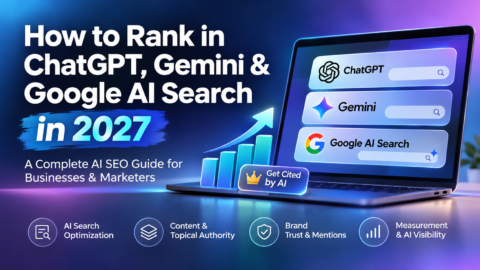




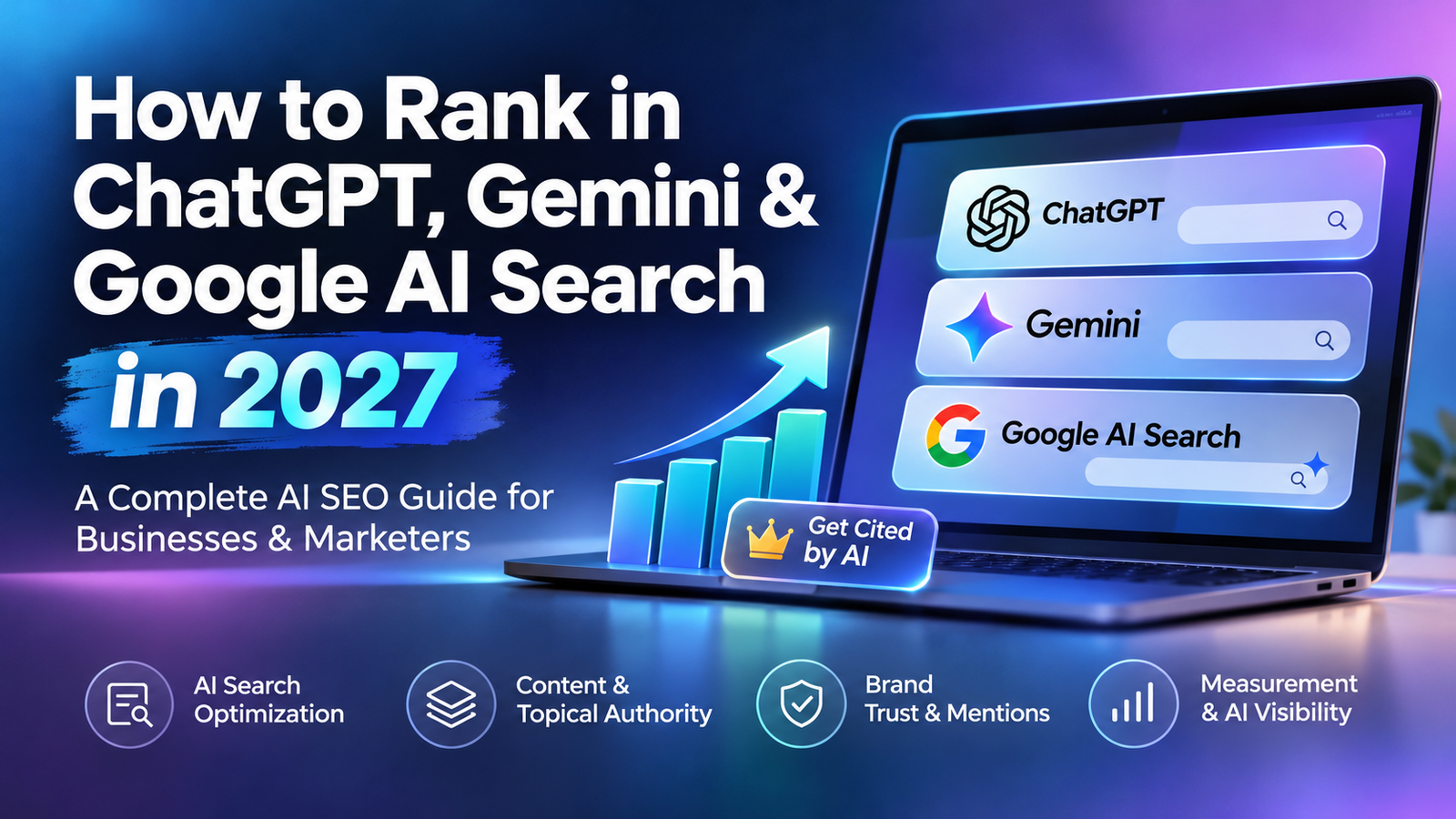
AI Search Optimization Guide for Businesses, Marketers & SEO Professionals
Search is changing.
People are no longer using Google only by typing short keywords. They are increasingly asking AI platforms such as ChatGPT, Gemini and Google AI Search detailed questions, comparisons and recommendations.
Instead of searching:
“Best digital marketing agency in Bhopal”
a user might ask:
“Which digital marketing agencies in Bhopal are best for Meta Ads and Google Ads?”
The answer may come from multiple websites, business profiles and other online sources.
This creates a new opportunity for businesses:
How do you make your brand one of the sources AI trusts?
What Is AI Search Optimization?
AI Search Optimization (AISO) is the process of optimizing your website, content and online presence so that AI-powered search systems can better discover, understand and potentially reference your brand.
Traditional SEO focuses heavily on ranking webpages for search queries.
AI search adds another objective:
Become a useful and trustworthy source that AI can use when answering a user’s question.
Google’s guidance indicates that the fundamental SEO practices used for traditional search also remain important for AI features such as AI Overviews and AI Mode.
Can You Actually Rank in ChatGPT?
Yes — but AI search visibility works differently from traditional Google rankings.
ChatGPT can search the web and provide links to relevant sources. However, there is no guaranteed “#1 ranking” position inside ChatGPT.
The better goal is:
Increase the probability that AI discovers, references or recommends your brand.
To achieve that, your website needs to be:
- Relevant
- Accessible
- Trustworthy
- Authoritative
- Well-structured
- Consistent across the web
- Rich in useful information
OpenAI also states that websites should allow OAI-SearchBot to crawl their content if they want to be eligible for inclusion in ChatGPT search.
1. Build a Strong SEO Foundation
One of the biggest misconceptions about AI SEO is that traditional SEO is becoming irrelevant.
It isn’t.
Your website still needs to be crawlable, indexable and technically accessible.
Your SEO foundation should include:
- Fast website performance
- Mobile-friendly design
- Clean URL structure
- XML sitemap
- Proper internal linking
- Optimized title tags
- Descriptive headings
- Canonical URLs
- Correct indexing
- Google Search Console
- Strong technical SEO
AI search doesn’t replace SEO — it expands the places where SEO can generate visibility.
2. Create Content Around Real Questions
AI search is fundamentally question-driven.
Therefore, don’t create content only around keywords.
Create content around the problems your audience wants to solve.
For example, instead of creating only:
“Google Ads Services”
Create supporting articles such as:
- How much should a business spend on Google Ads?
- Why are my Google Ads getting clicks but no sales?
- Google Ads vs Meta Ads: Which is better?
- How long does Google Ads take to generate results?
- How can I reduce Google Ads CPC?
- What conversion tracking should I use?
This builds topical authority around your subject.
3. Make Your Content Easy for AI to Understand
If you want your content to be referenced, don’t hide the important information.
Use:
Clear Headings
Break complex topics into logical sections.
Direct Answers
Answer the question early.
Specific Information
Use genuine:
- Numbers
- Examples
- Processes
- Data
- Case studies
- Results
Original Insights
Add information based on your own:
- Experience
- Research
- Experiments
- Client work
- Industry observations
Google emphasizes creating helpful, people-first content that provides original value rather than content produced primarily to manipulate search rankings.
4. Build Topical Authority
One article isn’t enough to establish expertise.
Suppose you are a performance marketing agency.
Instead of publishing random marketing articles, build a content cluster around Meta Ads.
Example:
Meta Ads
→ Meta Ads Strategy
→ Meta Ads Targeting
→ Meta Ads Creative Testing
→ Meta Ads Retargeting
→ Meta Ads Conversion Tracking
→ Meta Ads Lead Generation
→ Meta Ads Ecommerce
→ Meta Ads Optimization
→ Meta Ads Case Studies
Connect these articles with internal links.
This creates a stronger topical relationship between your pages.
5. Build Your Brand Across the Internet
Your website isn’t the only place AI can learn about your business.
Your brand can appear on:
- Google Business Profile
- YouTube
- Industry publications
- Business directories
- Review platforms
- Podcasts
- Interviews
- News websites
- Social media
- Third-party websites
This means AI visibility is becoming more than a website SEO problem.
It is becoming a brand visibility problem.
Make your:
Business name + services + expertise + location + company information
consistent across important platforms.
6. Earn High-Quality Mentions
Third-party mentions can strengthen your overall online authority.
For example, a digital marketing agency could gain visibility through:
- Industry publications
- Expert interviews
- Podcasts
- Marketing communities
- Original research
- Case studies
- Conferences
- LinkedIn discussions
- Expert commentary
The goal isn’t to generate hundreds of artificial mentions.
The goal is to become a recognized source of expertise.
7. Optimize for Conversational Search
Traditional search:
“best SEO agency Bhopal”
AI search:
“Which SEO agency in Bhopal would be suitable for a small business with a limited marketing budget?”
These searches are longer and more conversational.
Your content should answer questions such as:
- What?
- Why?
- How?
- When?
- Which?
- Who?
- Where?
- How much?
- What are the alternatives?
- Which option is better?
This allows one piece of content to potentially address many related search intents.
8. Use Structured Data Correctly
Structured data helps search engines understand specific information about your webpages.
Depending on your business, you may use relevant schema such as:
- Organization
- LocalBusiness
- Article
- Product
- Breadcrumb
- Event
- Person
However, schema markup is not an AI ranking shortcut.
Google does not require special AI-specific schema for inclusion in AI Overviews or AI Mode.
Use structured data as part of your overall SEO strategy.
9. Make Your Website Accessible to AI Crawlers
This is an important technical consideration.
If search engines or AI systems cannot access your important pages, they have less opportunity to discover your content.
Check your:
Technical SEO
- Robots.txt
- XML sitemap
- Noindex tags
- Canonical URLs
- HTTP status codes
- JavaScript rendering
- Internal links
- Server accessibility
For ChatGPT specifically, OpenAI recommends allowing OAI-SearchBot to crawl your website if you want your pages to be eligible for ChatGPT search results.
10. Don’t Publish Hundreds of AI-Generated Articles
AI makes content production incredibly easy.
But more content doesn’t automatically mean more visibility.
Publishing hundreds of generic articles with little original value can actually weaken the quality of your website.
Instead, focus on:
Fewer + Better + More Useful Content
A single article containing:
- Original research
- Expert insights
- Real examples
- First-hand experience
- Unique data
- Useful visuals
can be far more valuable than dozens of generic AI-generated articles.
Google’s guidance specifically emphasizes original, helpful content rather than content created primarily to manipulate search visibility.
11. Create Comparison Content
AI search is especially useful when users are making decisions.
This makes comparison content extremely valuable.
Examples:
Meta Ads vs Google Ads
SEO vs PPC
ChatGPT vs Gemini
Shopify vs WooCommerce
Agency vs Freelancer
In-house Marketing vs Agency
But don’t simply compare features.
Answer:
Who should choose A?
Who should choose B?
What are the disadvantages?
What does each option cost?
Which option works best for different situations?
This makes your content much more useful for AI-driven decision searches.
12. Publish Original Data
One of the strongest AI SEO strategies is creating information that doesn’t already exist everywhere.
For example:
“We analyzed 500 Meta Ads campaigns and found that…”
Or:
“Our Google Ads campaigns generated X leads across Y industries…”
Or:
“We tested three landing page structures and found…”
This creates unique information that other websites can reference.
Original research can therefore become a powerful source of authority.
13. Optimize for Google AI Search
Google’s AI Search experiences are becoming increasingly important for complex searches, comparisons and follow-up questions.
Google explains that AI Mode can perform multiple searches around a query and explore different aspects of a topic before generating a response.
This changes the SEO mindset.
Traditional SEO asks:
“Can I rank for this keyword?”
AI SEO asks:
“Can my website become a trusted source for this entire topic?”
That’s a much broader opportunity.
14. Optimize for Gemini
There isn’t a secret “Gemini ranking hack.”
The fundamentals remain important:
Be Discoverable
Make your content accessible to search engines.
Be Relevant
Answer the user’s actual question.
Be Authoritative
Demonstrate genuine expertise.
Be Original
Provide information that adds something new.
Be Consistent
Maintain accurate information across your online presence.
Strong SEO fundamentals therefore remain an important foundation for visibility within Google’s broader AI ecosystem.
15. Measure AI Search Visibility
SEO measurement is evolving.
Don’t track only:
- Rankings
- Organic traffic
- Impressions
- Clicks
Also start tracking:
AI Mentions
How frequently does AI mention your brand?
AI Citations
Which pages are being referenced?
Competitor Visibility
Which competitors appear when your brand doesn’t?
AI Referral Traffic
Are AI platforms sending users to your website?
Brand Presence
How frequently does your business appear for important questions?
Google has also introduced reporting for visibility in its generative AI search experiences through Search Console.
The 2027 AI SEO Framework
A simple framework to remember:
Crawlability → Relevance → Authority → Originality → Brand → Citations → Measurement
01 — Crawlability
Can search engines and AI systems access your content?
02 — Relevance
Does your content answer the user’s actual question?
03 — Authority
Why should your information be trusted?
04 — Originality
What information do you provide that others don’t?
05 — Brand
Is your business recognized consistently across the web?
06 — Citations
Are credible websites referencing your expertise?
07 — Measurement
Are you monitoring your AI search visibility?
AI Search SEO Checklist for 2027
Before publishing an important page, ask:
☑ Is the page crawlable?
☑ Is it indexable?
☑ Does it answer a genuine user question?
☑ Is the answer clear and direct?
☑ Does it demonstrate expertise?
☑ Does it contain original information?
☑ Are important claims supported?
☑ Does it have relevant internal links?
☑ Is your business information consistent?
☑ Does your brand have credible third-party visibility?
☑ Is the content better than existing results?
☑ Are you measuring AI visibility?
Final Takeaway
Ranking in ChatGPT, Gemini and Google AI Search in 2027 isn’t about discovering one secret optimization trick.
It’s about becoming a trusted, useful and discoverable source of information.
The brands most likely to succeed will combine:
Technical SEO + Helpful Content + Original Research + Topical Authority + Brand Visibility + Strong Digital Reputation
Traditional SEO isn’t disappearing.
It is becoming the foundation of AI search.
The question businesses should be asking in 2027 isn’t simply:
“How do I rank #1 on Google?”
It’s:
“When my potential customer asks AI about my industry, why should my brand be one of the sources it trusts?”
That is the future of search.