




What Is Google Ads Performance Max?
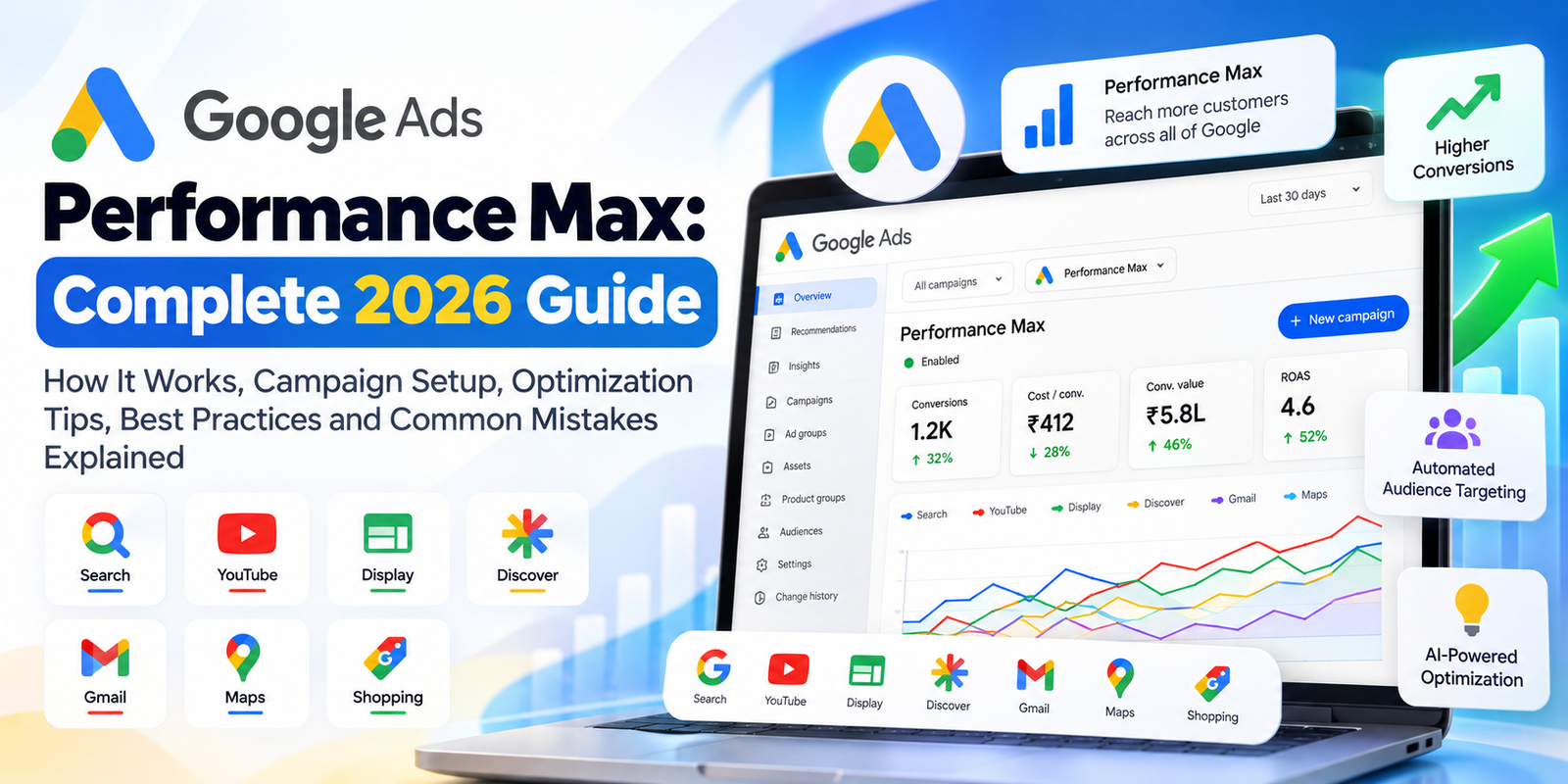
Google Ads Performance Max, commonly called PMax, is a campaign type designed to help advertisers reach potential customers across Google’s advertising ecosystem through a single campaign.
Instead of manually creating separate campaigns for every placement, Performance Max can distribute ads across multiple Google properties based on campaign objectives and available signals.
These can include:
- Google Search
- YouTube
- Display
- Discover
- Gmail
- Google Maps
- Shopping
Performance Max uses Google’s automated systems to determine where and when ads should appear.
In 2026, it has become an important part of many Google Ads strategies, particularly for eCommerce, lead generation, and businesses with sufficient conversion data.
How Does Performance Max Work?
Performance Max uses automation to optimize campaigns toward a chosen conversion goal.
Advertisers provide Google with important inputs such as:
- Conversion goals
- Budget
- Creative assets
- Audience signals
- Search themes
- Product feeds
- Location targeting
- Landing pages
Google’s systems then use these signals to identify users who are more likely to complete the desired action.
The desired conversion could be:
- Purchase
- Lead submission
- Phone call
- Booking
- Signup
- Store visit
The quality of your conversion tracking therefore has a major impact on campaign performance.
Why Conversion Tracking Matters
One of the biggest mistakes advertisers make is launching Performance Max without properly configuring conversion tracking.
If Google receives poor or incorrect conversion data, its automated bidding system may optimize toward the wrong users.
Before launching a PMax campaign, verify:
- Google Ads conversion tracking
- GA4 events
- GTM implementation
- Enhanced conversions where appropriate
- Primary and secondary conversion actions
- Revenue values for eCommerce
- Lead quality
For businesses generating leads, importing qualified leads or offline conversion data can make optimization significantly more meaningful.
Performance Max Campaign Structure
There is no universal campaign structure that works for every business.
For eCommerce, campaigns can often be organized around:
- Product categories
- Profit margins
- Geographic markets
- Business objectives
For lead generation, structure can be based on:
- Service categories
- Locations
- Lead value
- Customer segments
Avoid creating too many campaigns without enough conversion volume. Excessive fragmentation can make automation less effective.
Audience Signals
Audience signals help Google understand the types of users you consider valuable.
You can provide signals such as:
- Customer lists
- Website visitors
- Custom segments
- Demographic information
- Relevant search themes
However, audience signals should be treated as guidance rather than strict targeting.
Google may use them to explore additional users who demonstrate similar intent.
Creative Assets Matter
Performance Max relies heavily on creative assets.
Depending on the campaign, assets can include:
- Headlines
- Long headlines
- Descriptions
- Images
- Logos
- Videos
- Product information
Poor creative can limit campaign performance even when targeting and bidding are strong.
Create multiple variations and make sure messaging aligns with the landing page.
Your ad should clearly communicate:
Problem → Solution → Benefit → Call to Action
How to Optimize Performance Max in 2026
1. Improve Conversion Quality
Don’t optimize only for the number of conversions.
If 100 low-quality leads are generated but only five become customers, the campaign isn’t necessarily successful.
Track downstream business outcomes wherever possible.
2. Improve Landing Pages
Your landing page should match the intent of the advertisement.
Important elements include:
- Clear headline
- Strong offer
- Social proof
- Benefits
- Simple forms
- Trust signals
- Fast loading speed
- Mobile optimization
3. Use First-Party Data
Customer lists and first-party data can provide valuable signals, particularly as privacy changes continue to influence digital advertising.
4. Monitor Search Themes and Insights
Performance Max provides insights that can help advertisers understand the types of searches and audiences contributing to results.
Use these insights to improve:
- Creative messaging
- Landing pages
- Offers
- Keyword strategy
- Content
Common Performance Max Mistakes
Avoid these mistakes:
- Launching without proper tracking
- Using poor-quality creative
- Setting unrealistic budgets
- Tracking micro-actions as primary conversions
- Ignoring lead quality
- Changing campaigns too frequently
- Creating excessive campaign fragmentation
- Sending traffic to irrelevant landing pages
Final Thoughts
Performance Max can be a powerful component of a modern Google Ads strategy, but automation doesn’t eliminate the need for strategy.
The best results usually come from combining accurate conversion tracking, high-quality creative, strong landing pages, valuable first-party data, and continuous optimization.
Think of Performance Max as an automated engine.
Your job as an advertiser is to give that engine the right data, creative, goals, and business signals.