





For decades, the idea of living longer was largely associated with medicine, genetics and the hope of finding a cure for ageing. Today, the conversation is changing. Longevity is increasingly becoming a combination of lifestyle, technology, data, preventive healthcare and entrepreneurship.
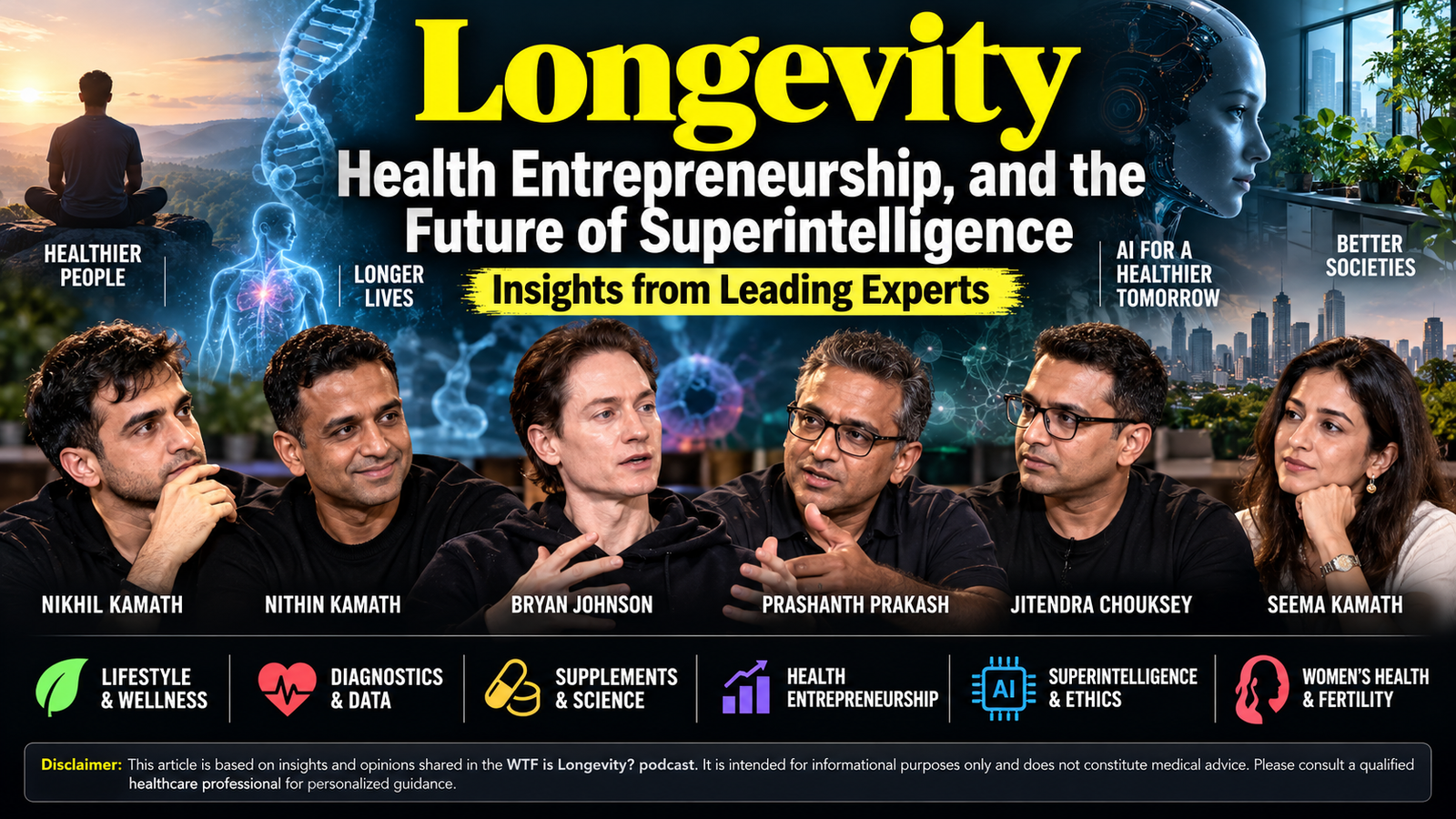
This shift was explored in depth in Nikhil Kamath’s WTF is Longevity? podcast, which brought together Nithin Kamath, Bryan Johnson, Prashanth Prakash, Jitendra Chouksey and Seema Kamath. The discussion moved far beyond supplements and fitness routines, raising bigger questions about how humans can improve health, how technology could transform healthcare and even whether artificial intelligence could eventually influence how we live.
Longevity Starts With the Environment
One of the first issues discussed was something most people rarely think about when talking about longevity: the air they breathe.
Air pollution, particularly fine particulate matter such as PM2.5, has become a major concern in many Indian cities. Unlike food or water, avoiding polluted air completely is almost impossible for people living in large urban environments.
This creates an interesting paradox. Humans can carefully select their food, exercise regularly and monitor their sleep, but they may still be exposed to harmful environmental conditions every time they step outside.
The podcast therefore raises an important idea: health optimization cannot stop at individual behaviour. The environment itself has to become part of the health equation.
This could create opportunities for businesses working on air purification, environmental monitoring, indoor health technologies and personalized health environments.
Bryan Johnson and the Rise of Data-Driven Longevity
Bryan Johnson has become one of the most recognizable personalities in the modern longevity movement. His approach is built around a highly structured lifestyle involving nutrition, exercise, sleep and extensive health measurements.
But perhaps the more important idea behind his approach is not any particular supplement or routine. It is the philosophy of measurement.
Instead of simply believing that something is healthy, the question becomes: Can we measure its effect?
Blood markers, glucose, cardiovascular indicators, body composition, sleep metrics and other biological measurements can potentially provide feedback about what is happening inside the body.
This represents a broader shift from generalized health advice to personalized health management.
The idea is relatively simple: two people may eat the same food, follow the same workout and take the same supplement, yet their bodies can respond differently. The future of healthcare could therefore become increasingly individualized.
The Supplement Question
Longevity has also created a huge market for supplements. NAD+ precursors, magnesium, vitamin D, omega-3s, rapamycin and numerous other compounds are frequently discussed in the anti-ageing world.
But the podcast takes a more cautious approach.
The important question is not simply “What supplement is popular?” but rather “What does my body actually need?”
This distinction matters because the science of ageing is still developing. Some interventions show interesting results in research environments, while their long-term effects in humans may remain uncertain.
That means supplementation should not replace the fundamentals: good nutrition, regular physical activity, sufficient sleep and appropriate medical monitoring.
In other words, longevity may be less about finding a magical pill and more about continuously understanding what your body needs.
From Healthcare to Health Entrepreneurship
Perhaps one of the most interesting aspects of the discussion is its focus on entrepreneurship.
The future of healthcare may not only belong to hospitals and pharmaceutical companies. There could be enormous opportunities in consumer diagnostics, personalized coaching, health monitoring, nutrition, preventive medicine and AI-powered healthcare.
Companies that can make complex health information easier to understand could potentially become extremely valuable.
Imagine a platform that combines blood tests, wearable data, nutrition, sleep and lifestyle information into one personalized health dashboard. Instead of simply telling someone that their cholesterol is high, such a system could potentially help connect multiple data points and identify patterns over time.
The challenge, however, is trust.
Consumers increasingly want to know what is actually inside their food, supplements and health products. Transparent testing, independent laboratory reports and reliable health information could therefore become important competitive advantages.
India’s Biggest Opportunity Could Be Data
Another major theme is particularly relevant to India: healthcare data.
Artificial intelligence is becoming increasingly powerful, but AI systems are only as useful as the data used to train them.
India has a massive population, but health data is often fragmented across hospitals, laboratories, clinics and different healthcare systems.
Creating high-quality, privacy-conscious and representative Indian health datasets could therefore become a major opportunity.
Health patterns in India may differ from those observed in Western populations because of differences in genetics, diet, pollution, lifestyle, socioeconomic conditions and disease patterns.
Building better India-specific datasets could help researchers and entrepreneurs develop healthcare technologies that are actually relevant to Indian patients.
Could AI Tell Us How to Live?
The conversation becomes even more philosophical when it moves toward artificial intelligence.
One thought experiment explored whether humans would eventually accept an algorithm that could tell them how to live the healthiest possible life.
Imagine an AI system that knows your medical history, genetics, sleep patterns, nutrition, exercise, environment and thousands of other variables.
It could theoretically recommend when you should sleep, what you should eat, how much you should exercise and which medical tests you should take.
Would people follow it?
And more importantly, should they?
The question introduces a conflict between optimization and freedom. A perfectly optimized life may not necessarily be the life a person wants to live.
Humans value spontaneity, relationships, pleasure, ambition and personal choice. The healthiest possible decision is not always the most meaningful one.
The “Don’t Die” Philosophy
The podcast also explores the provocative idea of giving future artificial intelligence a fundamental objective: “Don’t Die.”
At first, the idea sounds simple. Survival is one of the most basic biological instincts.
But once applied to a superintelligent system, the concept becomes much more complicated.
What does survival mean? Survival of one individual? Humanity? All living beings? What happens when human interests conflict with the system’s interpretation of survival?
These questions demonstrate why the future of AI cannot be discussed only in terms of computing power. It also requires conversations about ethics, values, autonomy and human responsibility.
Women’s Health Could Be the Next Major Frontier
The discussion eventually moves toward reproductive and women’s health, another area that remains relatively underserved.
Fertility, menopause, hormonal health and reproductive ageing involve complex biological processes that cannot be reduced to a single number or treatment.
As diagnostics become more sophisticated, researchers may gain a better understanding of these processes and potentially develop new approaches to reproductive and hormonal health.
This could become one of the most important areas of longevity research because living longer is only meaningful if people can maintain quality of life throughout those additional years.
The Real Goal of Longevity
Perhaps the biggest takeaway from the conversation is that longevity is not simply about extending the number on a person’s birth certificate.
It is about extending healthspan—the period of life in which a person remains physically capable, mentally sharp and independent.
Technology will undoubtedly play an increasingly important role. AI, diagnostics, wearables, biomarkers, regenerative medicine and personalized healthcare could transform how humans understand ageing.
But the foundation remains surprisingly familiar.
Sleep matters. Exercise matters. Nutrition matters. Mental health matters. Relationships matter. The environment matters.
The future may bring extraordinary technologies, but the smartest approach to longevity may still be to get the basics right first—and then use data and science to understand what comes next.
The ultimate question is therefore not simply “How long can we live?”
It may be:
“How long can we remain healthy, capable and fully alive?”
That is where the future of longevity truly begins.
Disclaimer: This article is based on insights, opinions, and discussions featured in the WTF is Longevity? podcast. It is intended for informational and educational purposes only and should not be considered medical advice. Longevity interventions, supplements, treatments, and emerging technologies discussed in the article may have varying levels of scientific evidence. Always consult a qualified healthcare professional before making decisions about your health, medication, supplements, or treatment.