




The future of high-performance automobiles may no longer be limited to four wheels on the road. Tesla’s next-generation Roadster has generated enormous attention with claims of technology that could allow the electric sports car to perform dramatic aerial manoeuvres. Developed with technology associated with SpaceX, the concept goes far beyond conventional electric-vehicle engineering and raises an intriguing question: could a performance car actually take to the air?
The reported Roadster concept combines extreme electric-car performance with a propulsion system based on compressed gas or cold-gas thrusters. Unlike conventional flying cars that depend on wings, propellers or large rotors, the proposed system is designed around short-duration thrust and vehicle-control mechanisms. If successfully developed and certified, it could represent one of the most unusual combinations of automotive and aerospace technology ever attempted.
A Different Approach to Flying
Traditional flying-car concepts generally resemble compact aircraft. They use wings, ducted fans, propellers or electric rotors to generate lift. Tesla’s reported approach is fundamentally different.
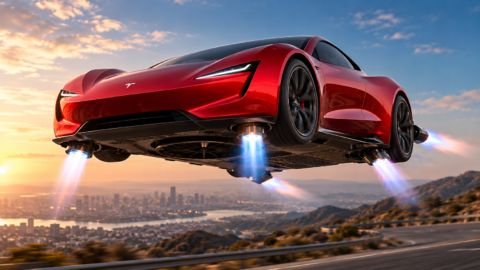
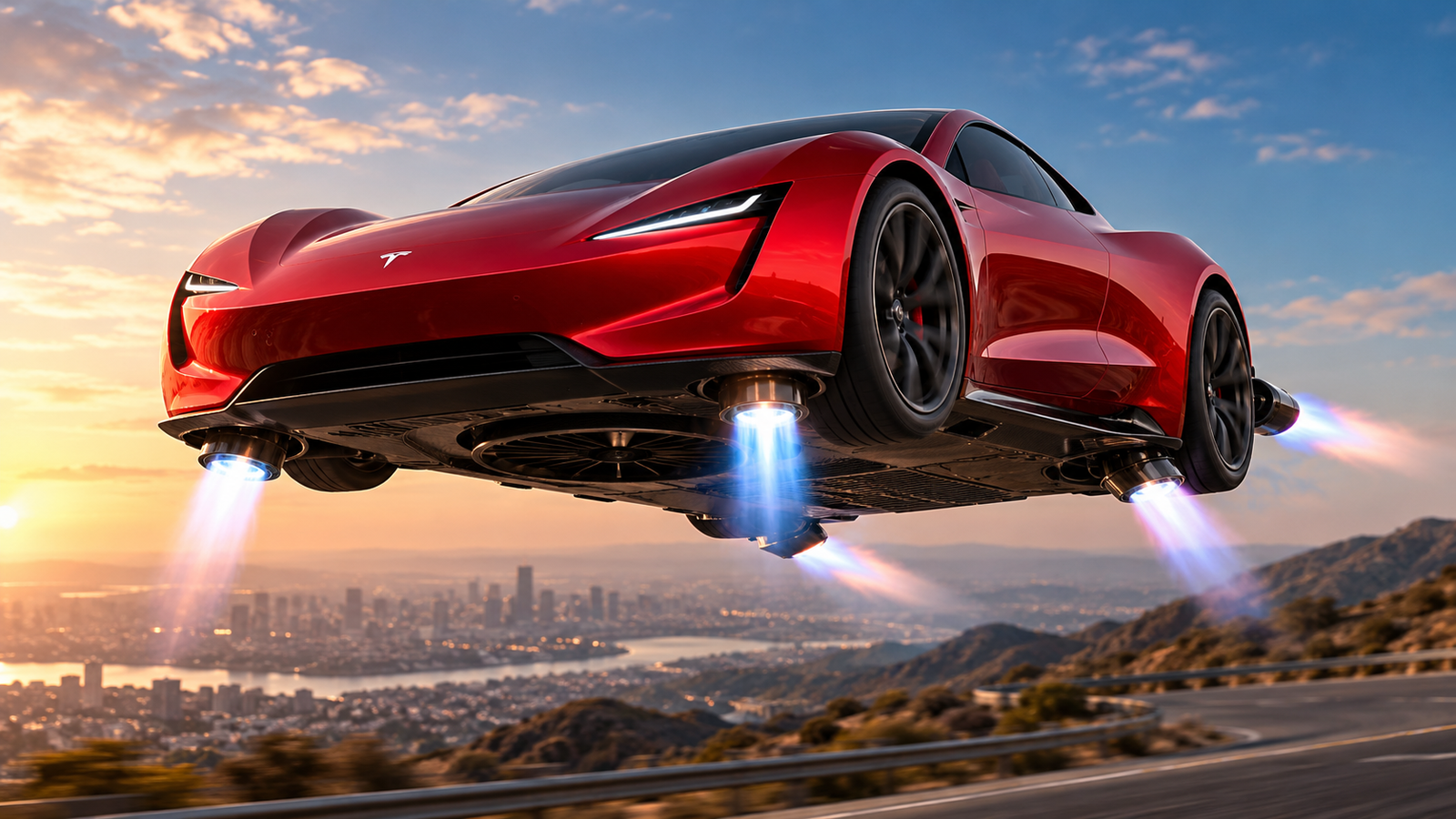
The Roadster has been associated with a SpaceX-derived cold-gas propulsion system that could provide additional thrust for acceleration and controlled aerial manoeuvres. Instead of continuously flying like an aircraft, the system is reportedly intended to deliver short bursts of propulsion.
This distinction is important. A vehicle capable of jumping, hovering briefly or performing controlled manoeuvres is not necessarily an aircraft capable of sustained flight. The technology therefore represents a hybrid concept between a high-performance automobile and an aerospace platform.
Cold-Gas Thrusters and Vehicle Control
The most dramatic element of the proposed system is the use of compressed gas. High-pressure gas can be released through specially designed nozzles to generate thrust.
According to reports surrounding the next-generation Roadster concept, multiple nozzles could be positioned around the vehicle. Rear-mounted thrusters would provide forward or vertical assistance, while additional nozzles could potentially help control rotation, pitch and other movements.
This type of system has an important advantage: rapid response. Electric motors are extremely effective for driving wheels, but controlling a vehicle in the air requires forces that can act independently of the tyres and road surface.
A distributed propulsion system could theoretically provide that control.
However, there are major engineering challenges. Compressed gas contains a finite amount of usable energy, meaning flight or aerial manoeuvres would be limited by the available pressure and storage capacity. Weight is another critical factor because pressure vessels, valves, plumbing and safety systems would add considerable mass to the vehicle.
The Role of Underbody Aerodynamics
Another reported feature is an advanced underbody suction or fan system.
Ground-effect and suction technologies can increase a vehicle’s aerodynamic grip by manipulating the air underneath it. In motorsport, the objective is to generate greater downforce without simply adding larger wings.
A sufficiently powerful suction system could theoretically create substantial aerodynamic adhesion between the vehicle and the road surface. Such technology could improve cornering, braking and high-speed stability.
The concept becomes particularly interesting when combined with an aerospace-style propulsion system. One technology could keep the vehicle firmly attached to the ground during high-performance driving, while another could provide additional thrust for specialised manoeuvres.
This would make the Roadster fundamentally different from conventional electric hypercars.
Performance Beyond Traditional Hypercars
Tesla has positioned the Roadster as an exceptionally fast vehicle, with previously announced performance targets including acceleration figures that would put it among the world’s quickest production cars.
Its potential competitors include vehicles such as the Rimac Nevera and Pininfarina Battista, both of which demonstrate how far electric propulsion has advanced.
The Nevera, for example, uses multiple electric motors and sophisticated torque control to deliver extraordinary acceleration and handling without any aerospace propulsion. The Battista follows a similar philosophy, combining electric power with luxury-car engineering.
The Roadster’s reported strategy, however, is to add another dimension: using aerospace technology to extend what an electric performance car can physically do.
Flying Cars Have a Different Challenge
It is important not to confuse the Roadster concept with companies developing genuine air-taxi aircraft.
Companies such as Joby Aviation and Archer Aviation are developing electric vertical-takeoff-and-landing aircraft designed specifically for sustained aerial transportation. Their vehicles rely on multiple electric propulsion units and aircraft-style flight systems.
A road-going vehicle faces a completely different engineering problem. It must satisfy automotive requirements while potentially managing aviation-level propulsion, structural loads, thermal management and safety considerations.
Certification would therefore be one of the biggest obstacles to any genuine flying Roadster.
What Could This Mean for the Automotive Industry?
If the technology reaches practical production, its biggest impact may not come from replacing conventional transportation. Instead, it could demonstrate how automotive and aerospace engineering can increasingly converge.
Active aerodynamics, high-density energy storage, autonomous control systems and lightweight materials are already transforming performance vehicles. Adding aerospace-derived propulsion could create an entirely new category of performance machines.
The technology could also influence future research into emergency vehicles, specialised military platforms, motorsport and personal transportation.
However, extraordinary claims require extraordinary engineering validation. Until independent demonstrations, detailed specifications and regulatory approvals are available, the Roadster’s most ambitious flight-related capabilities should be regarded as reported or claimed technology rather than established production specifications.
The Road Ahead
Tesla’s next-generation Roadster remains one of the most fascinating projects in the electric-vehicle industry. Its appeal comes from more than acceleration numbers. The vehicle represents an attempt to combine electric-car performance, advanced aerodynamics and aerospace technology in a single platform.
Whether it ultimately becomes a true flying performance car or remains primarily an ultra-fast road vehicle with specialised thrust-assisted capabilities, the project illustrates how rapidly the boundaries of automotive engineering are changing.
The real breakthrough may not simply be making a car fly. It may be demonstrating that technologies once restricted to rockets and aircraft can be engineered into a compact vehicle designed for the road.
For now, the Tesla Roadster remains a bold vision of the future—but one that could fundamentally change how we think about the limits of a performance automobile.