






India’s deep-tech startup ecosystem is moving beyond electric cars and air taxis. A startup incubated at IIT Madras is now preparing to take an unusual electric vehicle to the sea—an electric “flying boat” designed to skim just above the water.
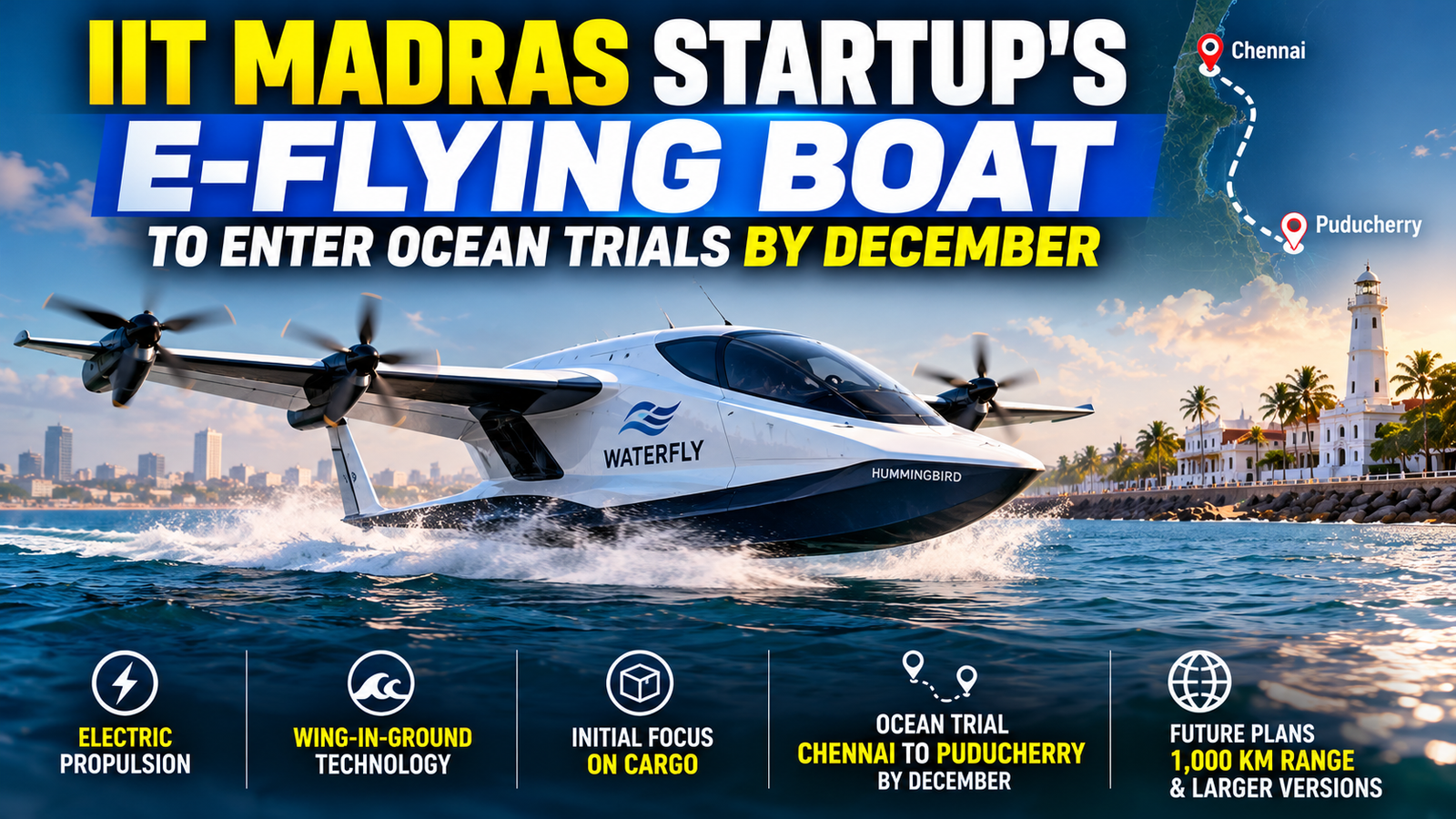
Waterfly Technologies plans to conduct the first ocean trial of its Hummingbird craft between Chennai and Puducherry by December 2026. The trial could become an important milestone for electric marine transportation and the commercialisation of Wing-in-Ground technology in India. Moneycontrol
What Exactly Is an E-Flying Boat?
The Hummingbird isn’t an aircraft that flies hundreds of metres above the ground.
Instead, it is designed around Wing-in-Ground (WIG) technology. The craft operates extremely close to the water’s surface, taking advantage of an aerodynamic phenomenon called the ground effect.
When a wing operates close to a surface, aerodynamic drag can be reduced and efficiency can improve. Waterfly is attempting to use this principle to create a vehicle that combines characteristics of a boat and an aircraft.
The concept could potentially provide higher speeds than conventional marine transport while avoiding some of the infrastructure requirements associated with traditional aircraft. Moneycontrol
From a 30-Kilogram Prototype to Hummingbird
Waterfly did not begin with the 300-kg Hummingbird.
According to the company, its development process started with a 30-kg prototype, which was used for roughly six months to understand how the craft could take off from water and transition into flight.
The company then spent another six months scaling the technology to a 300-kg craft.
The larger prototype has already been tested at Kaveripakkam Lake in Tamil Nadu. Some tests were conducted around 1.5 metres above the water to study the ground-effect phenomenon and improve the design. Moneycontrol
The upcoming ocean trial represents a much bigger challenge because open-sea conditions are considerably more unpredictable than controlled lake testing.
Chennai to Puducherry Will Be the Next Test
The planned Chennai–Puducherry trial is expected to test how the 300-kg craft behaves under actual ocean conditions.
That means the startup will need to evaluate factors such as stability, control, propulsion performance and the craft’s ability to operate in a changing marine environment.
Successful lake testing is important, but real-world ocean testing is where the technology faces its biggest validation challenge.
The December trial could therefore provide valuable data before Waterfly moves toward commercial deployment. Moneycontrol
Waterfly Is Starting With Cargo, Not Passengers
One of the most interesting aspects of Waterfly’s strategy is that it isn’t immediately positioning Hummingbird as an electric passenger ferry.
The startup plans to initially focus on cargo transportation, particularly coastal and island routes.
Potential applications include:
- Coastal logistics
- Island supply chains
- Offshore oil-field logistics
- Specialised cargo transportation
- Longer-distance coastal routes
This cargo-first approach could allow the company to focus on proving the technology before attempting the much more demanding task of passenger transportation.
1,000-Kilometre Range?
Waterfly has indicated that future versions could potentially travel approximately 1,000 km on a single charge, with charging stops of around 15 minutes.
The company is also exploring the idea of using ships equipped with solar panels and batteries as charging stations at sea.
However, these figures should currently be viewed as development targets or projections rather than demonstrated commercial performance. Actual range will depend on factors such as payload, weather, sea conditions, speed and battery performance. Moneycontrol
The Bigger Ambition: Shipping Containers
Waterfly’s long-term vision goes beyond the current 300-kg prototype.
The company plans to develop a significantly larger version capable of carrying a standard 20-foot shipping container.
Southeast Asia is among the potential initial target markets for this larger craft.
If the technology eventually reaches that scale, it could potentially serve specialised coastal logistics networks where speed and access are more important than conventional road or maritime infrastructure.
The startup has also discussed longer-term ambitions involving routes such as trans-Pacific, trans-Arctic and trans-Atlantic operations. Moneycontrol
Could It Be Cheaper Than Conventional Transport?
Cost is another major part of Waterfly’s proposition.
The company says it is targeting cargo transportation costs of below ₹10 per tonne-kilometre, based on its current design and operating-cost projections.
If such economics can be achieved at commercial scale, the technology could become particularly interesting for specialised logistics operations.
But this is another area where real-world testing will matter.
Manufacturing costs, battery replacement, maintenance, charging infrastructure, weather-related downtime, certification and operational staffing will all determine the final economics.
Certification Will Be Critical
Building a working prototype is only one part of commercialising a new transportation technology.
Waterfly is already discussing certification requirements with classification and certification organisations, including Bureau Veritas.
The regulatory pathway will be critical because an electric craft operating between marine and aviation-like environments doesn’t fit neatly into the conventional categories of road vehicles, boats or aircraft.
The company will therefore need to demonstrate that its craft can operate safely and reliably before commercial cargo operations can begin. Moneycontrol
Why This Matters for India’s Startup Ecosystem
The Hummingbird story is bigger than one electric boat.
India’s startup ecosystem has historically been strongest in software, fintech and consumer internet businesses. But companies emerging from institutions such as IIT Madras are increasingly working on deep-tech hardware.
IIT Madras itself highlights a growing ecosystem around deep-tech companies spanning electric mobility, aerospace, robotics, climate technology and advanced AI. SIE IIT Madras
Waterfly fits into this broader transition.
The company is attempting to solve a physical-world transportation problem using a combination of electric propulsion, aerodynamics, marine engineering and advanced manufacturing.
That’s considerably different from simply building another software application.
What Happens Next?
The December ocean trial will be the critical next milestone.
If the Hummingbird performs well in open-water conditions, Waterfly will have stronger evidence that its technology can progress beyond controlled testing.
But the trial won’t automatically mean commercial operations are ready.
The company will still need to demonstrate:
- Reliable ocean performance
- Battery and propulsion efficiency
- Safe operation in different sea conditions
- Commercially viable operating costs
- Certification and regulatory compliance
- Scalable manufacturing
- Reliable charging infrastructure
Only after these challenges are addressed can the technology move from an impressive prototype to a commercially useful transportation system.
Final Takeaway
Waterfly Technologies’ Hummingbird could represent an interesting new chapter in India’s electric mobility story.
Instead of keeping electric transportation limited to roads, the company is attempting to take the technology onto the water—and potentially into the air just above it.
The upcoming Chennai–Puducherry ocean trial in December 2026 will be an important reality check for the technology.
If Waterfly can successfully demonstrate that its Wing-in-Ground craft can operate efficiently and safely in real ocean conditions, the concept could have applications far beyond a single coastal route.
For now, the Hummingbird remains a developing technology rather than a proven commercial transport solution. But its progress highlights something important: India’s next wave of startups may increasingly be building machines for the physical world, not just software for the digital one.