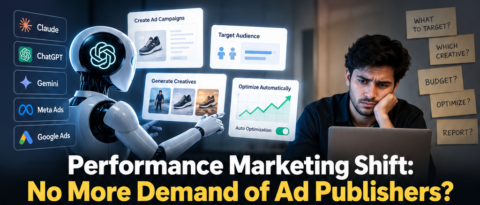



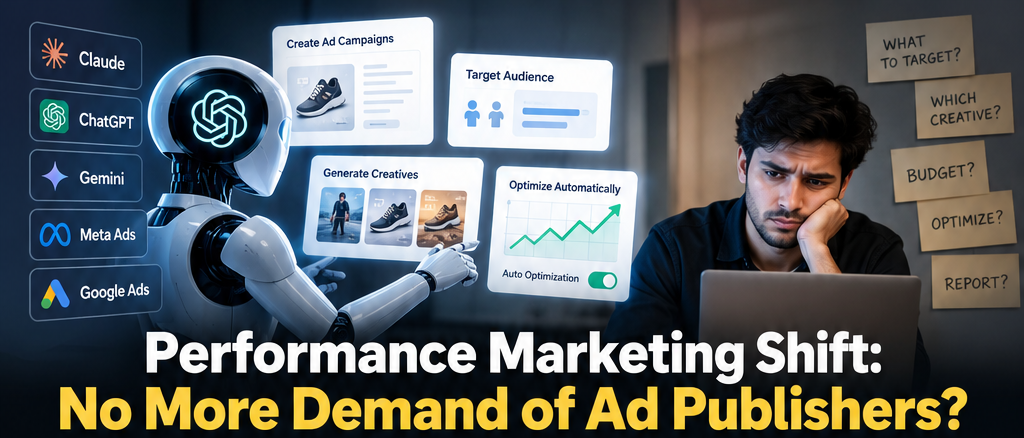
Performance marketing is entering a major transition. For years, businesses depended heavily on media buyers and ad publishers to create campaigns, select audiences, launch advertisements, monitor performance, and continuously optimize budgets.
Today, artificial intelligence is changing almost every one of these activities.
Tools such as Claude, ChatGPT, Gemini, Meta’s AI systems and Google’s automated campaign technologies can already assist with ad copy, creative ideas, audience analysis, campaign setup, optimization and performance analysis.
So the obvious question is:
If AI can do much of the work, will businesses still need performance marketers?
The answer is yes—but the role is changing dramatically.
AI Is Automating the Traditional Ad Publisher’s Job
The traditional ad publisher often operated around a relatively simple workflow:
Create campaign → choose audience → create ads → launch → monitor → optimize.
AI is increasingly capable of assisting with almost every step.
1. Automated Ad Creation
Generative AI can produce dozens of headlines, primary texts, descriptions, hooks and variations within seconds.
Instead of spending hours writing five versions of an advertisement, marketers can generate dozens and test the strongest combinations.
The marketer’s job is therefore moving from creating every asset manually to deciding which message actually makes sense for the business and customer.
2. Creative Production Is Becoming Faster
AI image and video tools can now generate product concepts, social media creatives, ad variations, scripts and visual ideas at an incredible speed.
A brand can test multiple creative angles without requiring a large production team for every experiment.
This doesn’t mean human creativity becomes irrelevant.
It means the competitive advantage moves toward creative strategy—understanding what should be communicated, why it should be communicated and which customer problem it should address.
3. Targeting Is Becoming More Automated
Audience targeting has also changed.
Platforms increasingly use machine learning to identify users who are likely to complete a desired action. Instead of manually building dozens of narrow interests and audience combinations, advertisers can provide conversion signals and allow the platform’s algorithms to find potential customers.
AI can analyze historical performance, customer behavior and campaign signals to identify patterns that would be difficult to discover manually.
The result is a major shift:
Less manual audience selection. More signal management.
4. Algorithms Are Making More Decisions
Meta and Google are increasingly becoming algorithm-driven advertising ecosystems.
Automated bidding, placements, budget allocation, creative testing and campaign optimization can happen continuously.
The platform doesn’t necessarily need someone changing bids every few hours.
It needs good inputs and reliable conversion signals.
That distinction is extremely important.
If your tracking is wrong, automation can simply optimize toward the wrong objective—faster.
Does This Mean Traditional Ad Publishers Will Disappear?
Not completely.
But basic campaign operators are increasingly replaceable.
If someone’s primary skill is:
- Creating campaigns
- Copy-pasting ad sets
- Changing budgets
- Creating basic audiences
- Uploading creatives
- Checking CPC every morning
- Turning advertisements on and off
then AI and platform automation will put significant pressure on that role.
Businesses will increasingly ask:
“Why should I pay someone just to operate the advertising interface?”
The more valuable question will become:
“Who can help me make the business grow profitably?”
That is where the opportunity exists.
The New Performance Marketer Is a Growth Strategist
The future performance marketer needs to understand much more than advertisements.
They need to understand the business behind the advertisements.
For example:
If a company generates leads at ₹200 each, that number alone doesn’t tell us whether the campaign is successful.
We need to know:
- How many leads become qualified?
- How many become customers?
- What is the CAC?
- What is the average order value?
- What is the customer lifetime value?
- What are the gross margins?
- How long does the sales cycle take?
- Which channel generates the highest-quality customers?
- What happens after the lead enters the CRM?
This is where human expertise becomes significantly more valuable.
Tracking Will Become a Major Competitive Advantage
One of the biggest opportunities for performance marketers is measurement and tracking.
AI can make recommendations, but those recommendations are only as good as the data available to the system.
Businesses therefore need professionals who understand:
GTM + GA4 + Meta Pixel + Conversions API + Google Ads tracking + CRM data + server-side tracking + attribution.
For example, if Meta reports 500 leads but the CRM shows that only 40 were qualified, optimizing campaigns purely around the 500-lead number could make the business worse.
The real job is to connect advertising data with business outcomes.
That’s where technical performance marketing becomes extremely valuable.
Stop Competing on Ad Spend
Another major shift is that brands don’t necessarily need to win by simply spending more.
A company spending ₹10 lakh isn’t automatically better positioned than a company spending ₹1 lakh.
The real question is:
Who has the better growth architecture?
A smaller brand can compete through:
- Better creative positioning
- Better landing pages
- Better conversion tracking
- Better offers
- Better customer segmentation
- Better remarketing
- Better CRM automation
- Better retention
- Better product-market fit
- Better use of first-party data
AI makes experimentation cheaper, which creates opportunities for businesses that previously couldn’t afford large marketing teams.
So, What Should Performance Marketers Do Now?
The solution isn’t to compete with AI.
Learn to use it.
A modern performance marketer should combine three capabilities:
1. AI & Automation
Use AI for research, copywriting, creative ideation, analysis, reporting and repetitive campaign tasks.
2. Technical Tracking
Master GTM, GA4, pixels, server-side tracking, CRM integrations and conversion architecture.
3. Business Strategy
Understand CAC, LTV, margins, ROAS, profitability, customer journeys and scaling requirements.
The marketer who combines all three becomes much harder to replace.
The Real Performance Marketing Shift
The industry isn’t moving from “human marketers to AI.”
It is moving from:
Ad Publisher → Performance Marketer → Growth Strategist
The first role focuses on operating platforms.
The second focuses on generating measurable results.
The third understands the entire business system.
AI will probably make advertising execution faster, cheaper and more automated.
But businesses will still need people who can answer the harder questions:
What should we advertise?
Who should we sell to?
Why should they buy?
How do we measure it correctly?
Where are we losing money?
And how do we scale profitably?
That is the opportunity.
The future doesn’t belong to the person who can publish the most ads.
It belongs to the person who can use AI, data, tracking and business strategy to turn advertising into profitable growth.