

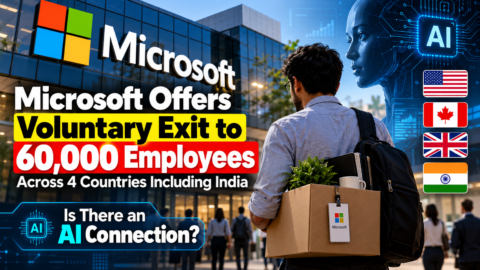



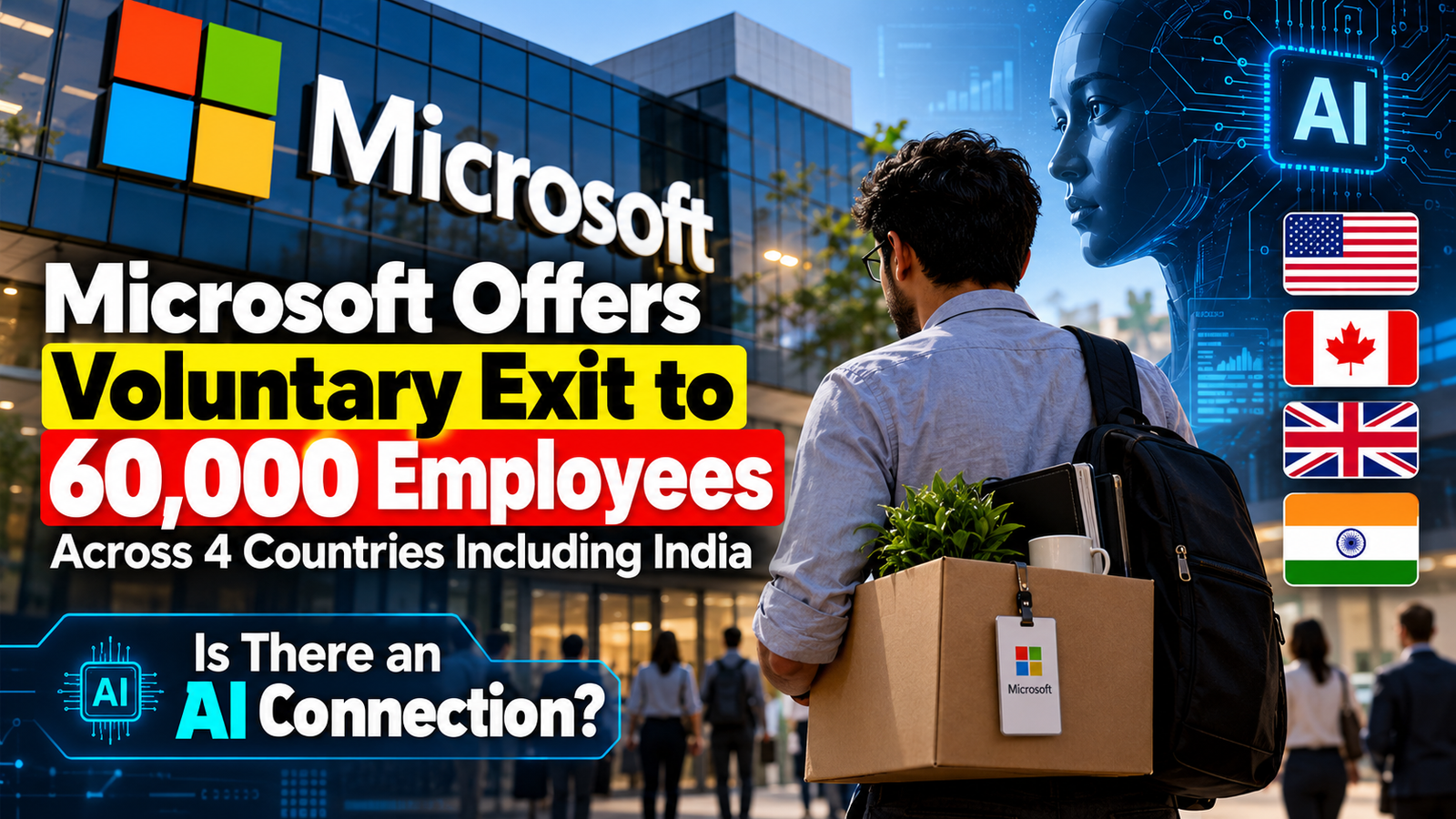
Microsoft has introduced a new Voluntary Exit Offer (VEO) that could make around 60,000 employees eligible to leave the company with financial and career-transition support. The programme covers participating teams in the United States, Canada, the United Kingdom and India.
The announcement has immediately raised a bigger question: Is artificial intelligence reshaping Microsoft’s workforce?
The answer is more complicated than simply saying “AI is replacing 60,000 jobs.” Microsoft has not said that. However, the timing of the programme, the company’s enormous AI investments and the changing nature of technology jobs suggest that AI is an important part of the broader workforce transformation taking place across the company.
What exactly has Microsoft announced?
Microsoft announced the Voluntary Exit Offer on October 26, 2026. According to the company’s official announcement, eligible employees in participating organisations across the four countries can voluntarily leave Microsoft while receiving financial support and career-planning resources.
The programme applies to employees at level 70 and below in participating teams. Importantly, this does not mean that 60,000 employees will be laid off.
The 60,000 figure represents the approximate number of employees who may be eligible for the offer. Microsoft has not announced how many employees it expects to accept it.
Microsoft also stressed that participation will vary between business units depending on business priorities, customer commitments and workforce requirements.
For employees in India, reports indicate that Microsoft has around 23,000 employees, although the company has not publicly disclosed how many Indian employees are eligible for the offer.
Why is AI becoming part of the conversation?
The obvious reason is Microsoft’s extraordinary investment in artificial intelligence.
Microsoft has been spending heavily on data centres, cloud infrastructure and computing capacity required to support AI products and services. Its AI ecosystem includes products such as Copilot, Azure AI services and a growing range of enterprise AI capabilities.
Reuters reported that Microsoft is forecasting approximately $175 billion in capital expenditure for 2026, with AI infrastructure representing a major component of its spending plans.
That creates an interesting economic equation.
Microsoft is simultaneously:
Investing more in computing infrastructure + expanding AI capabilities + managing operating costs + reassessing workforce requirements.
This does not necessarily mean AI is directly replacing every employee who leaves. Instead, it suggests that Microsoft is reallocating resources toward areas it considers strategically important for its next phase of growth.
AI isn’t just replacing jobs — it is changing which jobs matter
One of the biggest misunderstandings around AI and employment is the idea that companies simply replace humans with AI.
The reality is more nuanced.
AI can automate certain repetitive activities, accelerate software development, improve customer support, assist with data analysis and reduce the amount of manual work required in many corporate functions.
At the same time, AI creates demand for completely different capabilities — including AI engineering, infrastructure, cybersecurity, data centre operations, AI product management and specialised research.
This creates a workforce transition rather than a simple “humans versus AI” equation.
Microsoft itself says it will continue helping employees build new skills and explore internal career opportunities where appropriate.
That is an important signal.
The future workforce may not necessarily be smaller everywhere. It may simply be structured differently.
Interestingly, some AI-related teams are included
Reports citing people familiar with Microsoft’s plans indicate that the voluntary programme includes employees in areas such as AI experiences, Copilot, finance, human resources, Xbox and Windows + Devices.
At the same time, some areas — including certain marketing, commercial and security functions — are reportedly excluded.
This makes the “AI is replacing workers” explanation even less straightforward.
If AI were simply eliminating traditional technology jobs, we would expect the programme to follow a much cleaner pattern.
Instead, Microsoft’s approach appears to be about reorganising resources across multiple parts of the business.
AI teams themselves are not immune to restructuring because AI businesses are also evolving rapidly. A company can simultaneously hire aggressively for some AI capabilities while reducing or restructuring other roles.
Why offer voluntary exits instead of traditional layoffs?
Voluntary exit programmes give companies another way to reshape their workforce.
Instead of immediately terminating employees, companies can provide financial incentives to people who are already considering a career change, retirement or a move outside the organisation.
For Microsoft, this can potentially reduce long-term salary and benefit costs while giving employees more control over their departure.
It also gives the company an opportunity to identify where employees are willing to leave voluntarily before considering more disruptive workforce reductions.
Microsoft previously launched a voluntary retirement programme earlier in 2026. More than 30% of eligible employees reportedly accepted that offer.
The latest programme is broader because it does not rely on the same age and tenure requirements.
What does this mean for Microsoft employees in India?
India is particularly important to Microsoft because the country has become a major technology, engineering and services talent hub.
Microsoft says it remains committed to India’s technology ecosystem. The company has also announced $20.5 billion in committed investment in India between 2025 and 2029, covering cloud and AI infrastructure, skilling and operations. It has also stated a goal of equipping 20 million people in India with AI skills by 2030.
That creates an interesting contrast.
Microsoft is potentially offering voluntary exits to some employees in India while simultaneously increasing its AI and cloud investment in the country.
Rather than signalling that Microsoft is abandoning Indian talent, this may indicate a shift in the type of talent and skills the company needs.
The bigger lesson: AI is changing the workforce equation
The Microsoft announcement is significant not simply because 60,000 employees are eligible for a voluntary exit.
It is significant because it demonstrates how major technology companies are balancing AI investment against workforce costs.
The AI era requires enormous infrastructure investment. Data centres, chips, cloud capacity and energy are expensive. At the same time, companies must continue funding research, product development and highly specialised AI talent.
That forces companies to ask a difficult question:
Where should the next dollar of investment go — people, infrastructure, AI systems or new products?
Microsoft’s voluntary exit programme is one part of that broader calculation.
So, is AI responsible?
Partly — but it would be inaccurate to say that AI alone is responsible for the 60,000-person voluntary exit programme.
Microsoft officially describes the initiative as a way for participating organisations to adapt their workforce to changing business needs. The company has not stated that the programme is an AI-driven replacement of employees.
However, the programme comes at a time when Microsoft is making massive investments in AI infrastructure and products. That makes AI an important part of the broader strategic context.
The more important story may therefore not be “AI is taking 60,000 Microsoft jobs.”
It may be:
AI is changing what a technology company needs from its workforce — and Microsoft is beginning to reorganise around that new reality.
For employees, businesses and professionals everywhere, that could be the more important lesson.
The future of work may not be about whether AI replaces humans.
It may be about which humans know how to work effectively with AI — and which skills remain valuable as technology changes.