



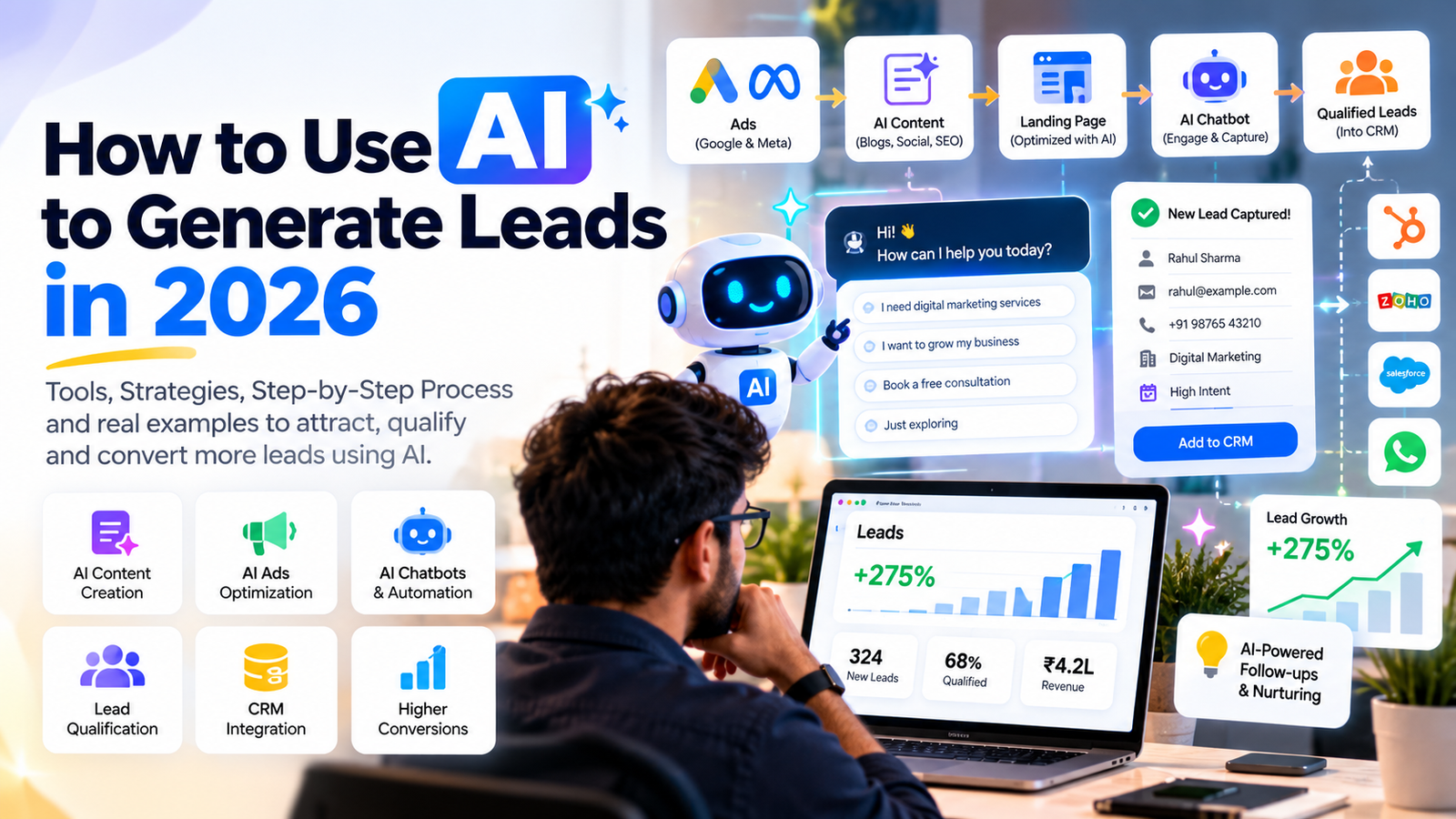
Why AI Lead Generation Matters in 2026
Generating leads has traditionally required significant time and resources.
Businesses had to research prospects, create content, launch advertising campaigns, respond to enquiries, qualify leads, and follow up manually.
AI is changing this process.
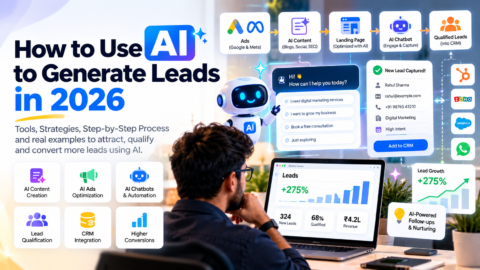
In 2026, businesses can use AI throughout the lead generation funnel to improve efficiency, personalize communication, automate repetitive tasks, and identify higher-quality prospects.
However, AI should not replace marketing strategy.
Instead, it should make a good strategy faster and more scalable.
What Is AI Lead Generation?
AI lead generation refers to using artificial intelligence to attract, identify, qualify, and nurture potential customers.
AI can support almost every stage of the funnel:
Traffic → Engagement → Lead → Qualification → Follow-up → Conversion
This makes AI particularly valuable for businesses that receive a large number of enquiries.
1. Use AI for Customer Research
Before generating leads, understand your ideal customer.
AI can help analyze:
- Customer problems
- Search behavior
- Reviews
- Competitor messaging
- Frequently asked questions
- Buying objections
- Customer segments
This information can then be used to create better advertising and content.
Instead of targeting everyone, businesses can develop detailed customer personas based on real customer needs.
2. Generate SEO Content With AI
AI can accelerate content production.
Businesses can use AI to generate:
- Blog ideas
- Content briefs
- FAQs
- Social media content
- Landing page variations
- Email sequences
- Video scripts
However, simply publishing AI-generated articles isn’t an effective SEO strategy.
Human expertise, original insights, accurate information, and useful content still matter.
The best approach is to use AI as a content assistant, while humans provide expertise and quality control.
3. Improve Paid Advertising
AI can help marketers analyze advertising data and identify patterns.
For platforms such as Meta Ads and Google Ads, AI can assist with:
- Ad copy
- Creative concepts
- Audience research
- Campaign analysis
- Performance reporting
- Keyword research
- Landing page ideas
You can also create multiple ad variations and test different messaging angles.
For example:
Problem-focused:
“Getting traffic but no qualified leads?”
Outcome-focused:
“Generate more qualified leads with a performance-focused advertising strategy.”
Different audiences respond to different messaging, so testing is essential.
4. Build AI-Powered Chatbots
One of the most practical applications of AI for lead generation is conversational marketing.
An AI chatbot can answer common questions and collect information such as:
- Name
- Phone number
- Requirement
- Budget
- Location
- Preferred service
Instead of waiting for a salesperson to respond, prospects can interact with the business immediately.
5. Automate Lead Qualification
Not every lead has the same value.
AI can help categorize leads based on factors such as:
- Buying intent
- Budget
- Requirement
- Location
- Company size
- Service interest
Leads can then be assigned different priorities.
For example:
Hot Lead → Sales team immediately
Warm Lead → Automated follow-up
Cold Lead → Nurture campaign
This allows sales teams to spend more time on high-value opportunities.
6. Connect AI With Your CRM
AI becomes significantly more powerful when connected to a CRM.
A typical automated workflow could look like:
Meta Lead Ad → CRM → AI Lead Qualification → WhatsApp/Email → Sales Team → Follow-up
Tools such as automation platforms can connect advertising platforms, forms, CRM systems, email, WhatsApp, and other business applications.
This creates a more efficient lead management system.
7. Use AI for Follow-Ups
Many leads don’t convert immediately.
AI can help create personalized follow-up sequences based on the prospect’s interests.
For example:
Day 1: Initial response
Day 2: Helpful information
Day 4: Case study
Day 7: Offer or consultation
Day 14: Final follow-up
The objective isn’t to spam prospects but to remain relevant throughout the buying journey.
Measure Lead Quality, Not Just Lead Quantity
One of the biggest mistakes businesses make is celebrating a low cost per lead without checking whether those leads become customers.
Track metrics such as:
- Cost per lead
- Qualified lead rate
- Cost per qualified lead
- Lead-to-customer conversion rate
- Customer acquisition cost
- Revenue generated
- Return on ad spend
This allows businesses to understand the actual ROI of AI-powered lead generation.
Final Thoughts
AI can significantly improve lead generation in 2026, but technology alone won’t create a successful marketing funnel.
The strongest approach combines:
AI + Data + Automation + Human Strategy
Use AI to research customers, create content, improve advertising, qualify leads, automate follow-ups, and analyze performance.
But keep human expertise at the center of your strategy.
Businesses that combine AI with strong marketing fundamentals can build lead generation systems that are faster, more scalable, and more efficient.