






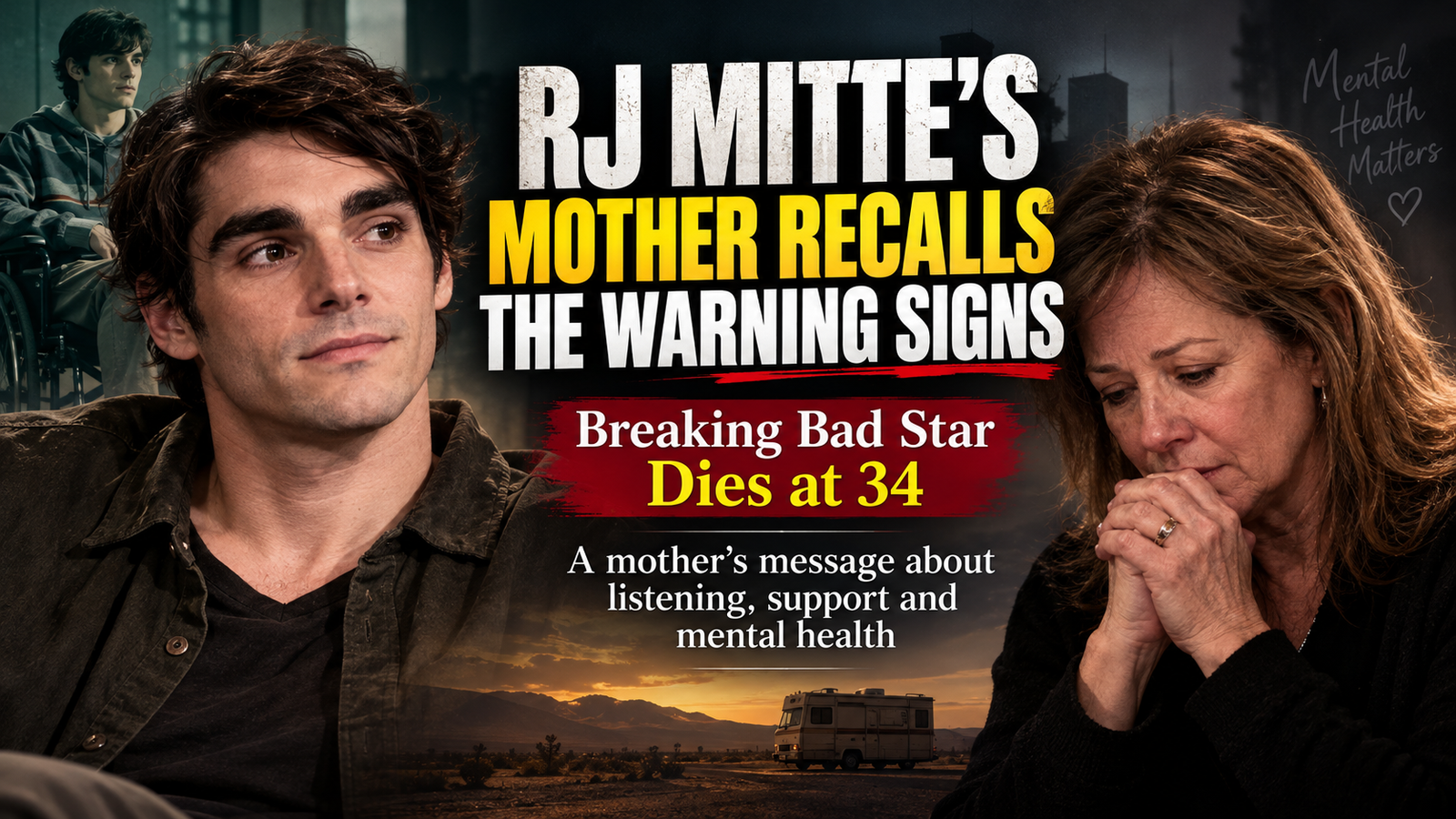
The sudden death of Breaking Bad star RJ Mitte at the age of 34 has left fans, friends and former co-stars mourning an actor whose career went far beyond television. In the days following his death, his mother, Dyna Mitte, has spoken publicly about the period leading up to the tragedy, including her concerns about her son and the support she encouraged him to seek.
Mitte, best known for playing Walter “Flynn” White Jr. in the acclaimed series Breaking Bad, died on October 12, 2026, in Brownsville, Texas. His representatives confirmed his death, while reports subsequently identified suicide as the cause. Authorities have separately said that their investigation was ongoing and that the official cause and manner were subject to confirmation.
His mother’s comments have now brought renewed attention to the importance of recognising emotional distress and encouraging people to seek professional help.
RJ Mitte’s Mother Speaks About the Difficult Period
In an interview referenced by the Times of India and other outlets, Dyna Mitte recalled that she had become concerned about her son in the months before his death.
She said she had encouraged RJ to consider therapy, believing that speaking with a professional could give him another perspective and help him work through what he was experiencing. According to reports, Mitte had reassured his mother that he was okay and could manage his difficulties himself.
Looking back, Dyna has expressed the painful feeling that she wished she had pushed harder for him to receive professional support.
Her comments highlight one of the most difficult realities for families dealing with mental-health concerns: sometimes a person may reassure those around them even while struggling internally.
That does not mean families can always recognise or prevent a crisis. But it does reinforce the importance of taking significant changes in behaviour, mood or communication seriously and approaching loved ones with patience and care.
A Career That Changed Representation
For millions of viewers, RJ Mitte will always be remembered as Walter White Jr., the son of Bryan Cranston’s Walter White in Breaking Bad.
The role was particularly significant because Mitte himself had cerebral palsy. He was diagnosed with the condition at the age of three and used his experiences to bring authenticity to a character who also had cerebral palsy.
Rather than allowing the condition to define his entire identity, the series presented Walter Jr. as a teenager with his own personality, frustrations, relationships and ambitions.
Mitte later became an important advocate for disability representation and inclusion. He served as an ambassador for organisations including United Cerebral Palsy and Shriners Children’s, while also becoming involved in philanthropic work through the Mitte Foundation.
His contribution therefore extended beyond acting. He helped demonstrate how greater representation in entertainment could create more authentic and multidimensional portrayals of people with disabilities.
His Family Remembered More Than the Actor
Recent tributes have also highlighted another side of Mitte’s life.
His younger sister, Lacianne Carriere, spoke about how RJ had taken on a significant role in her life after their mother’s accident when she was a baby. At a celebration of life in Brownsville, she described him not only as her brother but also as someone who had acted as a father figure.
According to her account, Mitte helped care for his younger sister and eventually became a major source of financial support for his family at a remarkably young age.
That part of his story offers a different perspective on the person behind the famous television character.
To audiences, he was Walter White Jr. To his family, he was a son, brother and deeply important part of their lives.
Bryan Cranston and the Breaking Bad Family React
Mitte’s death has also deeply affected his former Breaking Bad co-stars.
Bryan Cranston, who played his on-screen father, shared an emotional tribute remembering Mitte from the beginning of his time on the series. Cranston recalled meeting him when he was young and watching him develop as an actor.
Aaron Paul, Dean Norris and other members of the Breaking Bad family have also expressed their grief and remembered Mitte as a friend and colleague rather than simply a cast member.
The response from his former colleagues demonstrates the lasting relationships created during the show’s five-season run.
Breaking Bad ended in 2013, but the connections formed during those years continued long after the cameras stopped rolling.
His Final Public Reflections Have Taken on New Meaning
Mitte’s death has also led fans to revisit a recent interview in which he discussed Breaking Bad, Walter Jr.’s future and his own approach to life.
In what has been described as his final interview, Mitte spoke about the possibility that the story of the White family could continue and reflected on some of the most challenging scenes he had performed.
He also spoke about living life fully and acknowledged that time is limited. Those comments, made before his death, have understandably taken on a different emotional significance for audiences now.
However, it is important not to interpret past comments as proof of what someone was privately experiencing at a particular moment. A person’s public words cannot provide a complete picture of their mental or emotional state.
The Bigger Conversation About Mental Health
Perhaps the most important part of Dyna Mitte’s decision to speak publicly is the conversation it creates around mental health.
Families often notice changes in someone they love but may not know exactly what those changes mean. A person may appear successful, social or productive while privately dealing with emotional difficulties.
The lesson is not that every warning sign will reveal a crisis. Instead, it is that conversations about mental health should be treated with the same seriousness as conversations about physical health.
Encouraging someone to speak with a therapist, doctor or trusted professional can be an important step. So can simply asking someone how they are doing and genuinely listening to the answer.
Professional help is particularly important when someone may be at immediate risk.
Remembering RJ Mitte for His Life and Legacy
RJ Mitte’s story should ultimately be remembered for more than the circumstances of his death.
He was an actor who became internationally recognised through Breaking Bad. He was also a disability-rights advocate, philanthropist, brother and son who used his public platform to promote greater inclusion.
His portrayal of Walter White Jr. helped challenge conventional ideas about how disability could be represented on mainstream television. His advocacy continued outside the screen.
As his family and fans process his death, his mother’s decision to speak about the warning signs also carries a broader message: people experiencing emotional struggles deserve attention, compassion and professional support.
Mitte’s career may have been relatively short, but the impact of his work was significant.
For viewers who knew him as Walter White Jr., his performance will remain part of one of television’s most influential series. For the people who knew him personally, his legacy is much larger than a character on a screen.
If you or someone you know is struggling or experiencing thoughts of suicide, seek immediate support from a qualified mental-health professional or local emergency service. In the U.S., call or text 988 for the Suicide & Crisis Lifeline.
Disclaimer: This article discusses suicide and mental health. It is intended for informational purposes and does not provide medical or mental-health advice. It avoids graphic details and relies on publicly reported information. Details surrounding RJ Mitte’s death may be subject to updates as authorities complete their investigation.